FSCT07A-UH5
FSCT07A-UH5 is FAN SPEED CONTROLER manufactured by STMicroelectronics.
- Part of the FSCTxxA-UH5 comparator family.
- Part of the FSCTxxA-UH5 comparator family.
FEATURES
Built in thermal sensor Brushless DC fan speed control Linear control and regulation of the fan speed according to the temperature Green OFF mode operation with automatic turn- ON in case of overtemperature Voltage limitation above fan stall voltage No external NTC required s s s s s s
5 1
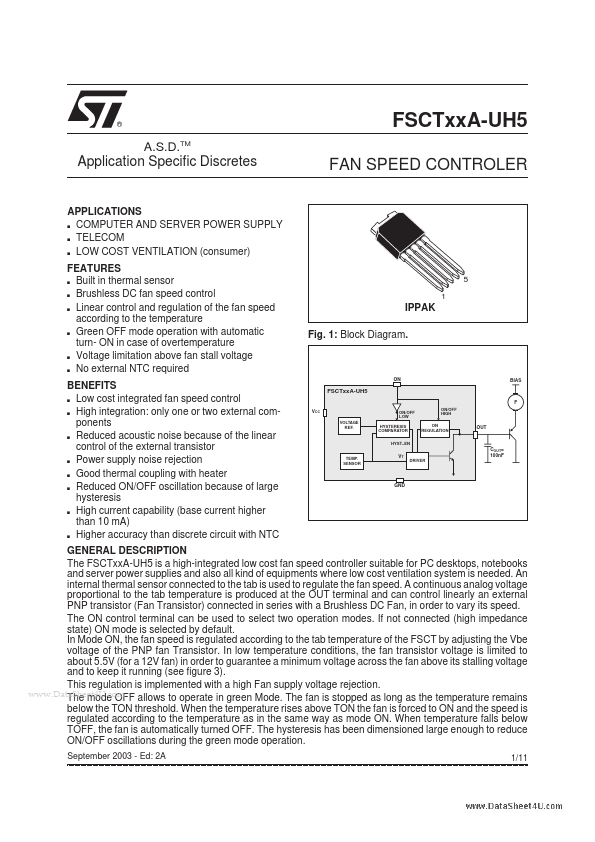
IPPAK Fig. 1: Block Diagram.
BENEFITS Low cost integrated fan speed control High integration: only one or two external ponents Reduced acoustic noise because of the linear control of the external transistor Power supply noise rejection Good thermal coupling with heater Reduced ON/OFF oscillation because of large hysteresis High current capability (base current higher than 10 m A) Higher accuracy than discrete circuit with NTC s s s s s s s s
BIAS
FSCTxx A-UH5
F VCC
VOLTAGE REF. ON/OFF LOW HYSTERESIS PARATOR HYST.-EN ON/OFF HIGH ON REGULATION
TEMP. SENSOR
DRIVER
COUT= 100n F
GENERAL DESCRIPTION
The FSCTxx A-UH5 is a high-integrated low cost fan speed controller suitable for PC desktops, notebooks and server power supplies and also all kind of equipments where low cost ventilation system is needed. An internal thermal sensor connected to the tab is used to regulate the fan speed. A continuous analog voltage proportional to the tab temperature is produced at the OUT terminal and can control linearly an external PNP transistor (Fan Transistor) connected in series with a Brushless DC Fan, in order to vary its speed. The ON control terminal can be used to select two operation modes. If not connected (high impedance state) ON mode is selected by default. In Mode ON, the fan speed is regulated according to the tab temperature of the FSCT by adjusting the Vbe voltage of the PNP fan Transistor. In low temperature conditions, the fan transistor voltage is limited to about 5.5V (for a 12V fan) in order to guarantee a minimum voltage across the fan above its stalling voltage and to keep it running (see figure 3). This regulation is implemented with a high Fan...