Datasheet4U Logo Datasheet4U.com

L6206PD - DMOS dual full bridge driver

This page provides the datasheet information for the L6206PD, a member of the L6206 DMOS dual full bridge driver family.

Datasheet Summary

Description

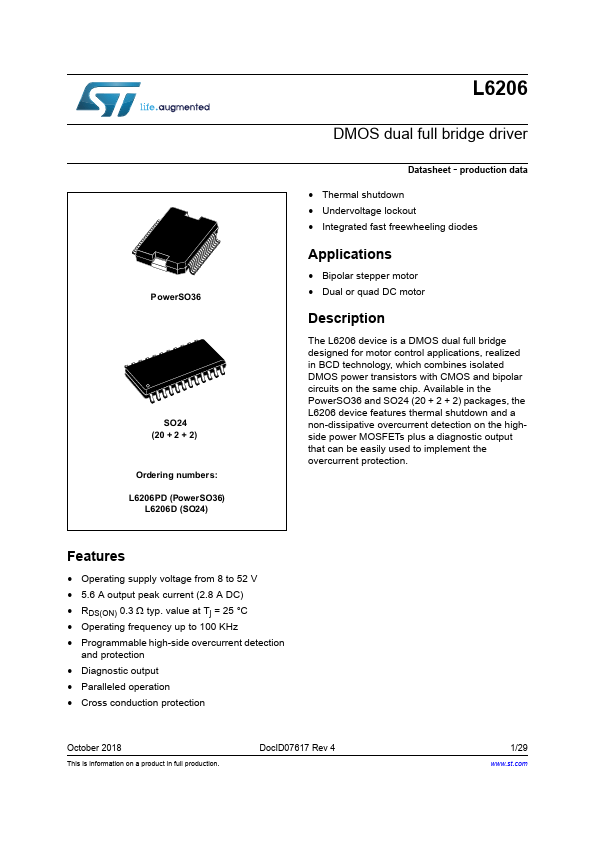
The L6206 device is a DMOS dual full bridge designed for motor control applications, realized in BCD technology, which combines isolated DMOS power transistors with CMOS and bipolar circuits on the same chip.

Features

  • thermal shutdown and a non-dissipative overcurrent detection on the highside power MOSFETs plus a diagnostic output that can be easily used to implement the overcurrent protection. Features.
  • Operating supply voltage from 8 to 52 V.
  • 5.6 A output peak current (2.8 A DC).
  • RDS(ON) 0.3  typ. value at Tj = 25 °C.
  • Operating frequency up to 100 KHz.
  • Programmable high-side overcurrent detection and protection.
  • Diagnostic output.
  • Paralleled operation.
  • Cross conduc.

📥 Download Datasheet

Datasheet preview – L6206PD

Datasheet Details

Part number L6206PD
Manufacturer STMicroelectronics
File Size 613.40 KB
Description DMOS dual full bridge driver
Datasheet download datasheet L6206PD Datasheet
Additional preview pages of the L6206PD datasheet.
Other Datasheets by STMicroelectronics

Full PDF Text Transcription

Click to expand full text
3 RZHU62 62  2UGHULQ JQXPEHU V /1 3RZHU',3 /3' 3RZHU62 /' 62 L6206 DMOS dual full bridge driver Datasheet - production data  Thermal shutdown  Undervoltage lockout  Integrated fast freewheeling diodes Applications  Bipolar stepper motor  Dual or quad DC motor Description The L6206 device is a DMOS dual full bridge designed for motor control applications, realized in BCD technology, which combines isolated DMOS power transistors with CMOS and bipolar circuits on the same chip. Available in the PowerSO36 and SO24 (20 + 2 + 2) packages, the L6206 device features thermal shutdown and a non-dissipative overcurrent detection on the highside power MOSFETs plus a diagnostic output that can be easily used to implement the overcurrent protection.
Published: |