Datasheet4U Logo Datasheet4U.com

SBB5089 - Cascadable Active Bias InGaP/GaAs HBT MMIC Amplifier

This page provides the datasheet information for the SBB5089, a member of the SBB-5089 Cascadable Active Bias InGaP/GaAs HBT MMIC Amplifier family.

Datasheet Summary

Description

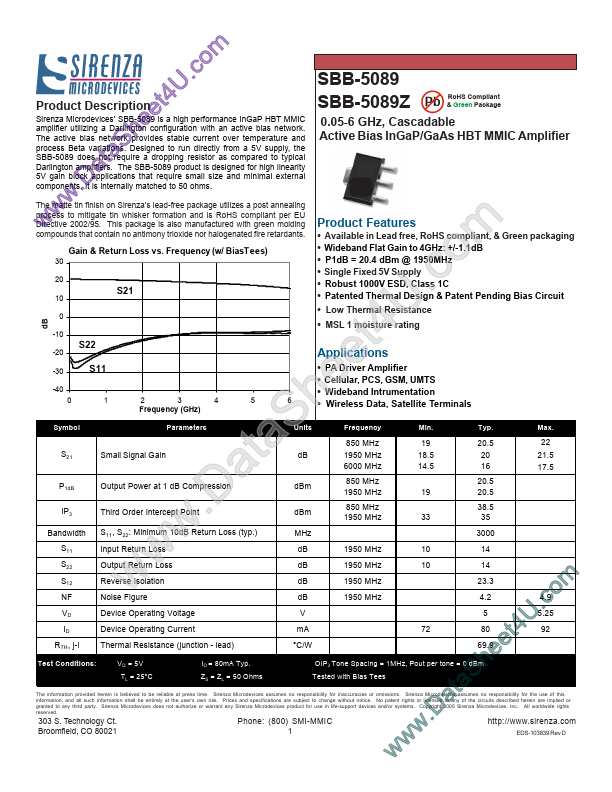
Sirenza Microdevices’ SBB-5089 is a high performance InGaP HBT MMIC amplifier utilizing a Darlington configuration with an active bias network.

The active bias network provides stable current over temperature and process Beta variations.

Features

  • Gain & Return Loss vs. Frequency (w/ BiasTees) S21 Available in Lead free, RoHS compliant, & Green packaging Wideband Flat Gain to 4GHz: +/-1.1dB P1dB = 20.4 dBm @ 1950MHz Single Fixed 5V Supply Robust 1000V ESD, Class 1C Patented Thermal Design & Patent Pending Bias Circuit Low Thermal Resistance MSL 1 moisture rating dB 0 -10 -20 -30 -40 0 1 2 3 Frequency (GHz) Parameters S22 S11 4 5 Symbol S21 Small Signa.

📥 Download Datasheet

Datasheet preview – SBB5089

Datasheet Details

Part number SBB5089
Manufacturer Sirenza Microdevices
File Size 143.71 KB
Description Cascadable Active Bias InGaP/GaAs HBT MMIC Amplifier
Datasheet download datasheet SBB5089 Datasheet
Additional preview pages of the SBB5089 datasheet.
Other Datasheets by Sirenza Microdevices

Full PDF Text Transcription

Click to expand full text
Product Description Sirenza Microdevices’ SBB-5089 is a high performance InGaP HBT MMIC amplifier utilizing a Darlington configuration with an active bias network. The active bias network provides stable current over temperature and process Beta variations. Designed to run directly from a 5V supply, the SBB-5089 does not require a dropping resistor as compared to typical Darlington amplifiers. The SBB-5089 product is designed for high linearity 5V gain block applications that require small size and minimal external components. It is internally matched to 50 ohms. The matte tin finish on Sirenza’s lead-free package utilizes a post annealing process to mitigate tin whisker formation and is RoHS compliant per EU Directive 2002/95.
Published: |