TC358870XBG
TC358870XBG is Mobile Peripheral manufactured by Toshiba.
Overview
TC358870XBG, Ultra HD to DSI, bridge converts high resolution (higher than 4 Gbps) HDMI® stream to MIPI® DSI Tx video. It is a follow up device of TC358779XBG, without scalar functionality. The HDMI-RX runs at 297 MHz to carry up to 7.2 Gbps video stream. It requires dual link MIPI DSI Tx, 1 Gbps/data lane, to transmit out a maximum 7.2 Gbps video data.
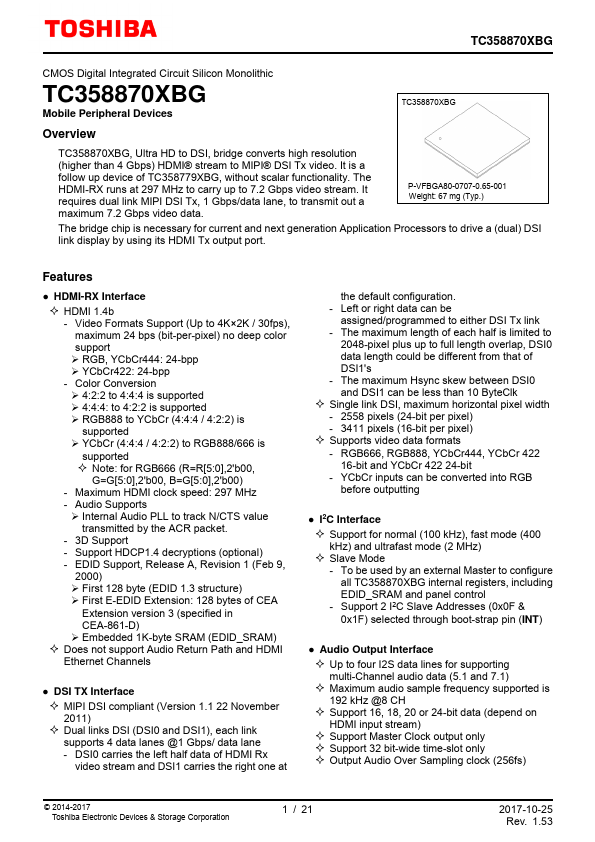
P-VFBGA80-0707-0.65-001 Weight: 67 mg (Typ.)
The bridge chip is necessary for current and next generation Application Processors to drive a (dual) DSI link display by using its HDMI Tx output port.
Features
- HDMI-RX Interface
- HDMI 1.4b
- Video Formats Support (Up to 4K×2K / 30fps), maximum 24 bps (bit-per-pixel) no deep color support
- RGB, YCb Cr444: 24-bpp
- YCb Cr422: 24-bpp
- Color Conversion
- 4:2:2 to 4:4:4 is supported
- 4:4:4: to 4:2:2 is supported
- RGB888 to YCb Cr (4:4:4 / 4:2:2) is supported
- YCb Cr (4:4:4 / 4:2:2) to RGB888/666 is supported
- Note: for RGB666 (R=R[5:0],2'b00, G=G[5:0],2'b00, B=G[5:0],2'b00)
- Maximum HDMI clock speed: 297 MHz
- Audio Supports
- Internal Audio PLL to track N/CTS value transmitted by the ACR packet.
- 3D Support
- Support HDCP1.4 decryptions (optional)
- EDID Support, Release A, Revision 1 (Feb 9, 2000)
- First 128 byte (EDID 1.3 structure)
- First E-EDID Extension: 128 bytes of CEA Extension version 3 (specified in CEA-861-D)
- Embedded 1K-byte SRAM (EDID_SRAM)
- Does not support Audio Return Path and HDMI Ethernet Channels
- DSI TX Interface
- MIPI DSI pliant (Version 1.1 22 November 2011)
- Dual links DSI (DSI0 and DSI1), each link supports 4 data lanes @1 Gbps/ data lane
- DSI0 carries the left half data of HDMI Rx video stream and DSI1 carries the right one at the default configuration.
- Left or right data can be assigned/programmed to either DSI Tx link
- The maximum length of each half is limited to
2048-pixel plus up to full length overlap, DSI0 data length could be different from that of DSI1's
- The maximum Hsync skew between DSI0 and DSI1 can be...