

TC74HC123AF Datasheet Text
TC74HC123AP/AF
TOSHIBA CMOS Digital Integrated Circuit Silicon Monolithic
TC74HC123AP, TC74HC123AF
Dual Retriggerable Monostable Multivibrator
The TC74HC123A is a high speed CMOS MONOSTABLE MULTIVIBRATOR fabricated with silicon gate C2MOS technology.
It achieves the high speed operation similar to equivalent LSTTL while maintaining the CMOS low power dissipation.
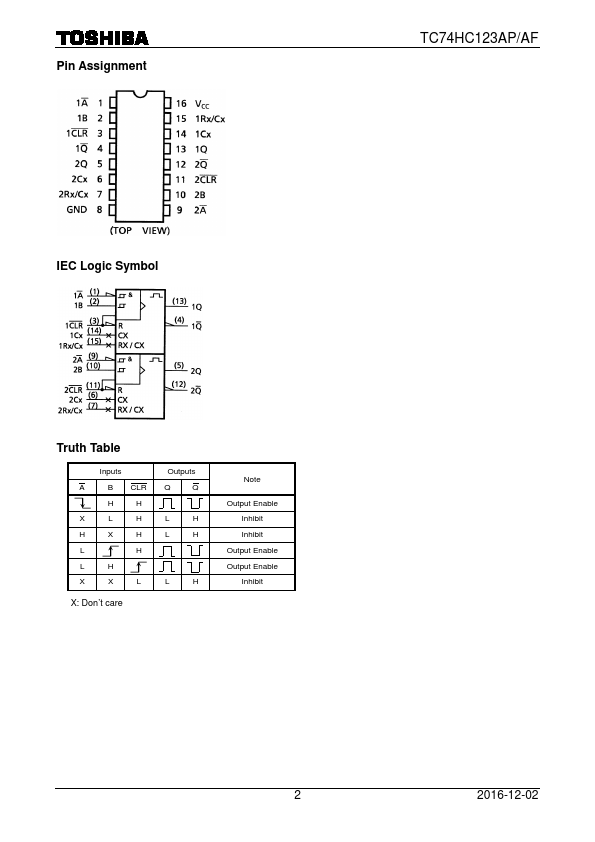
There are two trigger inputs, A input (negative edge), and B input (positive edge). These inputs are valid for a slow rise/fall time signal (tr = tf = 1 s) as they are schmitt trigger inputs. This device may also be triggered by using CLR input (positive edge).
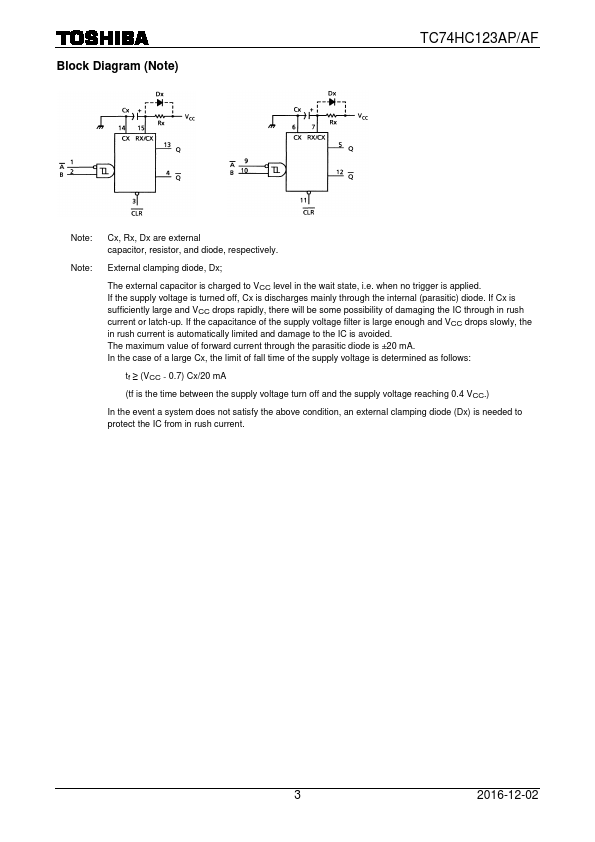
After triggering, the output stays in a MONOSTABLE state for a time period determined by the external resistor and capacitor (Rx, Cx ). A low level at the CLR input breaks this state. In the MONOSTABLE state, if a new trigger is applied, it extends the MONOSTABLE period (retrigger mode).
Limits for Cx and Rx are: External capacitor, Cx: No limit External resistor, Rx: VCC = 2.0 V more than 5 kΩ VCC ≥ 3.0 V more than 1 kΩ
All inputs are equipped with protection circuits against static discharge or transient excess voltage.
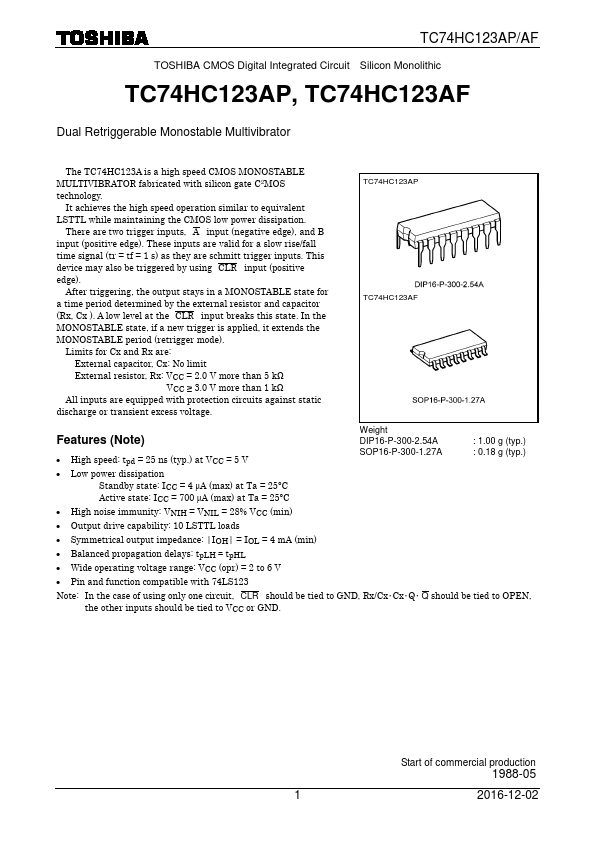
TC74HC123AP TC74HC123AF
Features
(Note)
- High speed: tpd = 25 ns (typ.) at VCC = 5 V
Weight DIP16-P-300-2.54A SOP16-P-300-1.27A
: 1.00 g (typ.) : 0.18 g (typ.)
- Low power dissipation Standby state: ICC = 4 μA (max) at Ta = 25°C Active state: ICC = 700 μA (max) at Ta = 25°C
- High noise immunity: VNIH = VNIL = 28% VCC (min)
- Output drive capability: 10 LSTTL loads
- Symmetrical output impedance: |IOH| = IOL = 4 mA (min)
- Balanced propagation delays: tpLH ∼- tpHL
- Wide operating voltage range: VCC (opr) = 2 to 6 V
- Pin and function patible with 74LS123
Note: In the case of using only one circuit, CLR should be tied...