Datasheet4U Logo Datasheet4U.com

TC74VCX2574FK - Low-Voltage Octal D-Type Flip-Flop

Download the TC74VCX2574FK datasheet PDF. This datasheet also covers the TC74VCX2574FT variant, as both devices belong to the same low-voltage octal d-type flip-flop family and are provided as variant models within a single manufacturer datasheet.

Key Features

  • 26-Ω series resistors on outputs.
  • Low-voltage operation: VCC = 1.8 to 3.6 V.
  • High-speed operation: tpd = 5.1 ns (max) (VCC = 3.0 to 3.6 V) : tpd = 6.2 ns (max) (VCC = 2.3 to 2.7 V) : tpd = 9.8 ns (max) (VCC = 1.8 V).
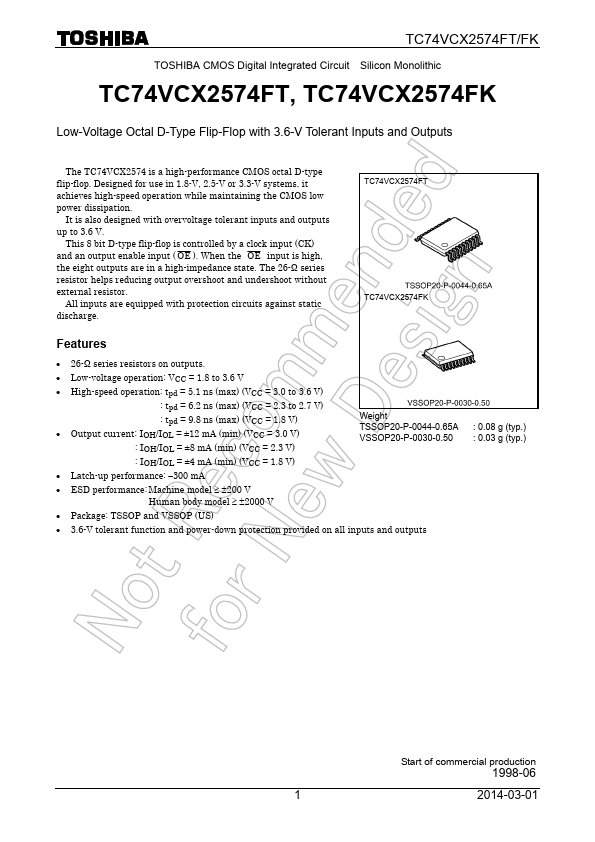
  • Output current: IOH/IOL = ±12 mA (min) (VCC = 3.0 V) : IOH/IOL = ±8 mA (min) (VCC = 2.3 V) Weight TSSOP20-P-0044-0.65A VSSOP20-P-0030-0.50 : IOH/IOL = ±4 mA (min) (VCC = 1.8 V).
  • Latch-up performance:.
  • 300 mA.
  • ES.

📥 Download Datasheet

Note: The manufacturer provides a single datasheet file (TC74VCX2574FT_ToshibaSemiconductor.pdf) that lists specifications for multiple related part numbers.

Datasheet Details

Part number TC74VCX2574FK
Manufacturer Toshiba
File Size 265.33 KB
Description Low-Voltage Octal D-Type Flip-Flop
Datasheet download datasheet TC74VCX2574FK Datasheet

Full PDF Text Transcription (Reference)

The following content is an automatically extracted verbatim text from the original manufacturer datasheet and is provided for reference purposes only.

View original datasheet text
TC74VCX2574FT/FK TOSHIBA CMOS Digital Integrated Circuit Silicon Monolithic TC74VCX2574FT, TC74VCX2574FK Low-Voltage Octal D-Type Flip-Flop with 3.6-V Tolerant Inputs and Outputs The TC74VCX2574 is a high-performance CMOS octal D-type flip-flop. Designed for use in 1.8-V, 2.5-V or 3.3-V systems, it achieves high-speed operation while maintaining the CMOS low power dissipation. It is also designed with overvoltage tolerant inputs and outputs up to 3.6 V. This 8 bit D-type flip-flop is controlled by a clock input (CK) and an output enable input ( OE ). When the OE input is high, the eight outputs are in a high-impedance state. The 26-Ω series resistor helps reducing output overshoot and undershoot without external resistor.