DRV8402
DRV8402 is Dual Full Bridge PWM Motor Driver manufactured by Texas Instruments.
Not Remended for New Designs
.ti.
Dual Full Bridge PWM Motor Driver
Check for Samples: DRV8402
SLES222
- FEBRUARY 2009
Features
- High-Efficiency Power Stage (up to 96%) with Low RDS(on) MOSFETs (80 mΩ at TJ = 25°C)
- Operating Supply Voltage up to 50 V (65 V Absolute Maximum)
- 10 A Continuous Output Current and 24 A Peak Current per Device
- PWM Operating Frequency up to 500 k Hz
- Integrated Self-Protection Circuits
- Programmable Cycle-by-Cycle Current Limit Protection
- Independent Supply and Ground Pins for Each Half Bridge
- Intelligent Gate Drive and Cross Conduction Prevention
- No External Snubber or Schottky Diode is Required
- Thermally Enhanced DKD (36-pin PSOP3) Package
The DRV8402 can operate at up to 500 k Hz switching frequency while still maintaining precise control and high efficiency. It also has an innovative protection system integrated on-chip, safeguarding the device against a wide range of fault conditions that could damage the system. These safeguards are short-circuit protection, overcurrent protection, undervoltage protection, and two-stage thermal protection. The DRV8402 has a current-limiting circuit that prevents device shutdown during load transients such as motor start-up. A programmable overcurrent detector allows adjustable current limit and protection level to meet different motor requirements.
The DRV8402 has unique independent supply and ground pins for each half bridge, which makes it possible to provide current measurement through external shunt resistor and support multiple motors with different power supply voltage requirements.
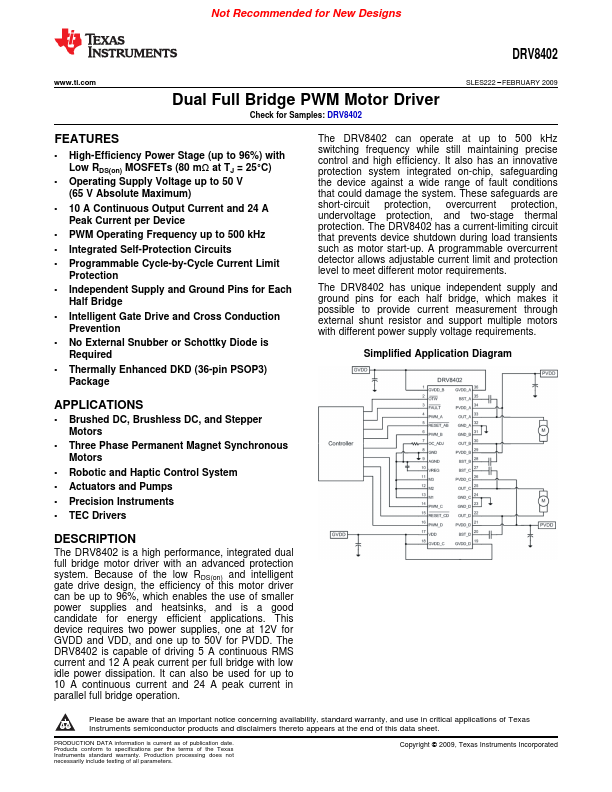
Simplified Application Diagram
APPLICATIONS
- Brushed DC, Brushless DC, and Stepper Motors
- Three Phase Permanent Magnet Synchronous Motors
- Robotic and Haptic Control System
- Actuators and Pumps
- Precision Instruments
- TEC Drivers
DESCRIPTION
The DRV8402 is a high performance, integrated dual full bridge motor driver with an advanced protection system. Because of the...