Download TPS76628D Datasheet PDF
Texas Instruments
TPS76628D
TPS76628D is LOW DROPOUT VOLTAGE REGULATOR manufactured by Texas Instruments.
- Part of the TPS76601 comparator family.
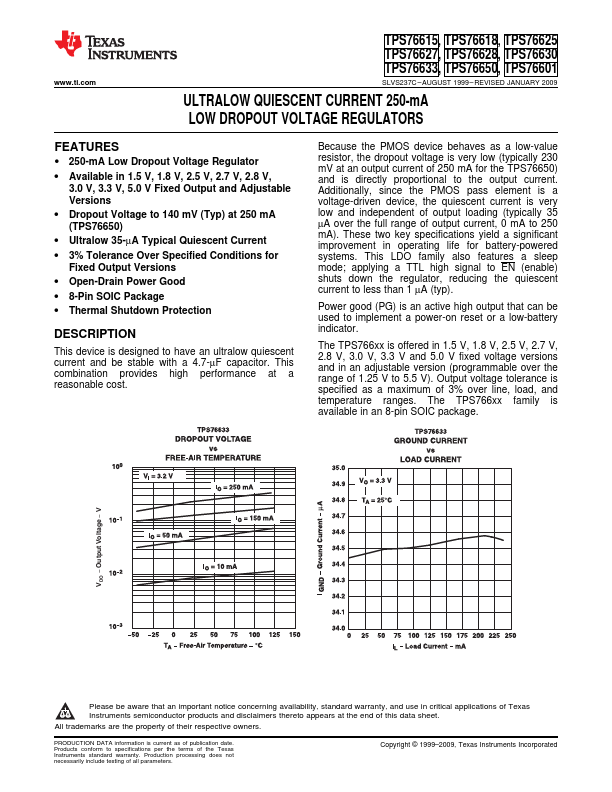
URES - 2 250-m A Low Dropout Voltage Regulator - Available in 1.5 V, 1.8 V, 2.5 V, 2.7 V, 2.8 V, 3.0 V, 3.3 V, 5.0 V Fixed Output and Adjustable Versions - Dropout Voltage to 140 m V (Typ) at 250 m A (TPS76650) - Ultralow 35-µA Typical Quiescent Current - 3% Tolerance Over Specified Conditions for Fixed Output Versions - Open-Drain Power Good - 8-Pin SOIC Package - Thermal Shutdown Protection DESCRIPTION This device is designed to have an ultralow quiescent current and be stable with a 4.7-µF capacitor. This bination provides high performance at a reasonable cost. Because the PMOS device behaves as a low-value resistor, the dropout voltage is very low (typically 230 m V at an output current of 250 m A for the TPS76650) and is directly proportional to the output current. Additionally, since the PMOS pass element is a voltage-driven device, the quiescent current is very low and independent of output loading (typically 35 µA over the full range of output current, 0 m A to 250 m A). These two key specifications yield a significant improvement in operating life for battery-powered systems. This LDO family also Features a sleep mode; applying a TTL high signal to EN (enable) shuts down the regulator, reducing the quiescent current to less than 1 µA (typ). Power good (PG) is an active high output that can be used to implement a power-on reset or a low-battery indicator. The TPS766xx is offered in 1.5 V, 1.8 V, 2.5 V, 2.7 V, 2.8 V, 3.0 V, 3.3 V and 5.0 V fixed voltage versions and in an adjustable version (programmable over the range of 1.25 V to 5.5 V). Output voltage tolerance is specified as a maximum of 3% over line, load, and temperature ranges. The TPS766xx family is available in an 8-pin SOIC package. - Output Voltage - V Please be aware that an important notice concerning availability, standard warranty, and use in critical applications of Texas Instruments semiconductor products and disclaimers thereto appears at the end of this data sheet. All trademarks are...