Datasheet4U Logo Datasheet4U.com

LM6588 - TFT-LCD Quad/ 16V RRIO High Output Current Operational Amplifier

Datasheet Summary

Description

The LM6588 is a low power, high voltage, rail-to-rail inputoutput amplifier ideally suited for LCD panel VCOM driver and gamma buffer applications.

The LM6588 contains four unity gain stable amplifiers in one package.

Features

  • fast slewing and settling times, along with a high continuous output capability of 75mA. This output stage is capable of delivering approximately 200mA peak currents in order to charge or discharge capacitive loads. These features are ideal for use in TFT-LCDs. The LM6588 is available in the industry standard 14-pin SO package and in the space-saving 14-pin TSSOP package. The amplifiers are specified for operation over the full.
  • 40˚C to +85˚C temperature range. Features (VS = 5V, TA = 2.

📥 Download Datasheet

Datasheet preview – LM6588

Datasheet Details

Part number LM6588
Manufacturer National Semiconductor
File Size 603.67 KB
Description TFT-LCD Quad/ 16V RRIO High Output Current Operational Amplifier
Datasheet download datasheet LM6588 Datasheet
Additional preview pages of the LM6588 datasheet.
Other Datasheets by National Semiconductor

Full PDF Text Transcription

Click to expand full text
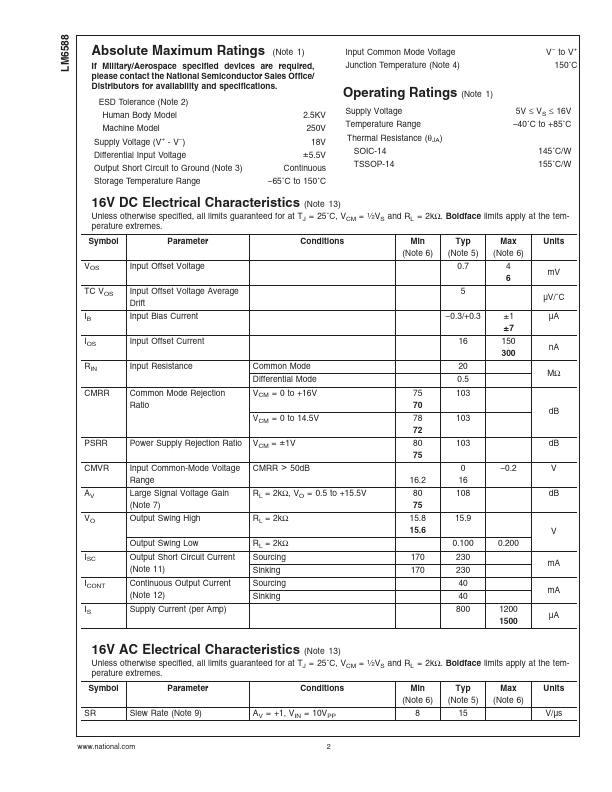
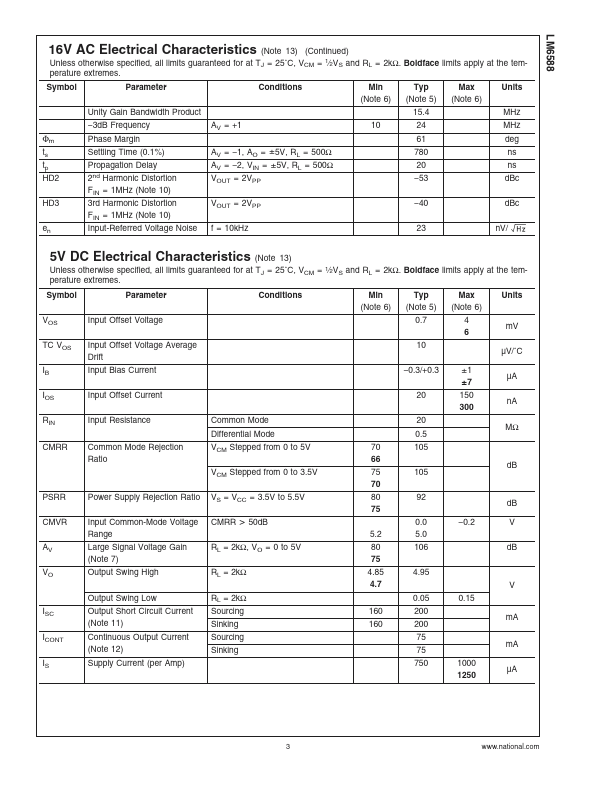
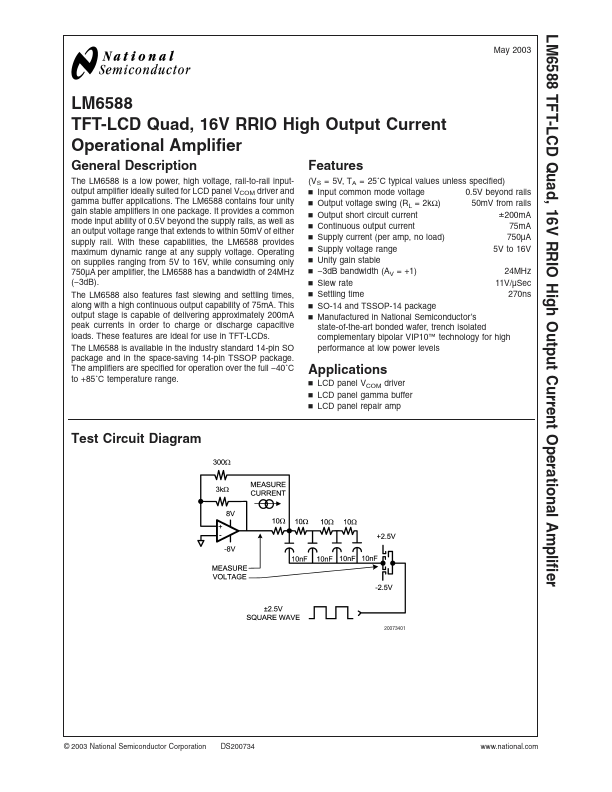
LM6588 TFT-LCD Quad, 16V RRIO High Output Current Operational Amplifier May 2003 LM6588 TFT-LCD Quad, 16V RRIO High Output Current Operational Amplifier General Description The LM6588 is a low power, high voltage, rail-to-rail inputoutput amplifier ideally suited for LCD panel VCOM driver and gamma buffer applications. The LM6588 contains four unity gain stable amplifiers in one package. It provides a common mode input ability of 0.5V beyond the supply rails, as well as an output voltage range that extends to within 50mV of either supply rail. With these capabilities, the LM6588 provides maximum dynamic range at any supply voltage. Operating on supplies ranging from 5V to 16V, while consuming only 750µA per amplifier, the LM6588 has a bandwidth of 24MHz (−3dB).
Published: |