AMMC-6241
AMMC-6241 is Low Noise Amplifier manufactured by Agilent Technologies.
Features
- Wide frequency range: 26
- 43 GHz
- High gain: 20 d B
- Low 50 Ω Noise Figure: 2.7 d B
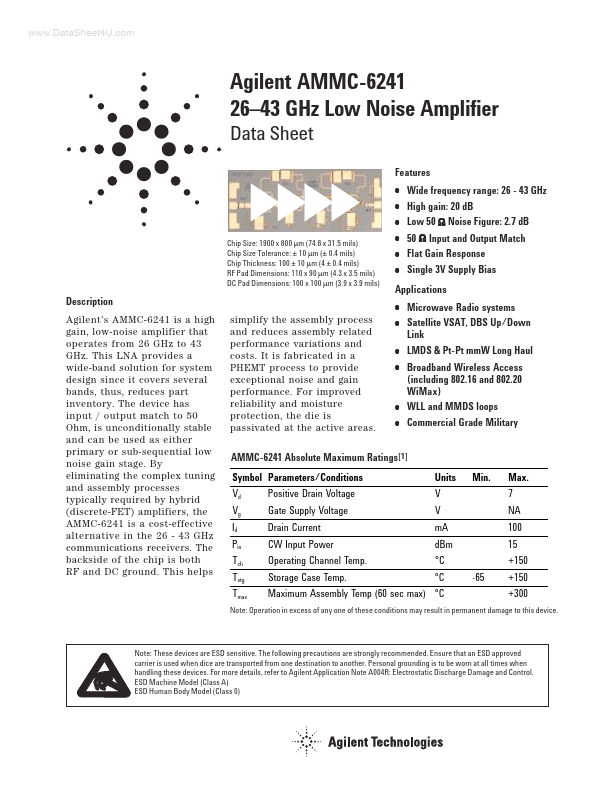
Chip Size: 1900 x 800 µm (74.8 x 31.5 mils) Chip Size Tolerance: ± 10 µm (± 0.4 mils) Chip Thickness: 100 ± 10 µm (4 ± 0.4 mils) RF Pad Dimensions: 110 x 90 µm (4.3 x 3.5 mils) DC Pad Dimensions: 100 x 100 µm (3.9 x 3.9 mils)
- 50 Ω Input and Output Match
- Flat Gain Response
- Single 3V Supply Bias Applications
- Microwave Radio systems
- Satellite VSAT, DBS Up/Down Link
- LMDS & Pt-Pt mm W Long Haul
- Broadband Wireless Access (including 802.16 and 802.20 Wi Max)
- WLL and MMDS loops
- mercial Grade Military
Description
Agilent’s AMMC-6241 is a high gain, low-noise amplifier that operates from 26 GHz to 43 GHz. This LNA provides a wide-band solution for system design since it covers several bands, thus, reduces part inventory. The device has input / output match to 50 Ohm, is unconditionally stable and can be used as either primary or sub-sequential low noise gain stage. By eliminating the plex tuning and assembly processes typically required by hybrid (discrete-FET) amplifiers, the AMMC-6241 is a cost-effective alternative in the 26
- 43 GHz munications receivers. The backside of the chip is both RF and DC ground. This helps simplify the assembly process and reduces assembly related performance variations and costs. It is fabricated in a PHEMT process to provide exceptional noise and gain performance. For improved reliability and moisture protection, the die is passivated at the active areas.
AMMC-6241 Absolute Maximum Ratings[1]
Symbol Parameters/Conditions Vd Vg Id Pin Tch Tstg Tmax Positive Drain Voltage Gate Supply Voltage Drain Current CW Input Power Operating Channel Temp. Storage Case Temp.
Units V V m A d Bm °C °C
Min.
Max. 7 NA 100 15 +150
-65
+150 +300
Maximum Assembly Temp (60 sec max) °C
Note: Operation in excess of any one of these conditions may result in permanent damage to this device.
Note: These devices are ESD sensitive. The following...