A8290
A8290 is Single LNB Supply and Control Voltage Regulator manufactured by Allegro MicroSystems.
Features and Benefits
- 2-wire serial I2C™ -patible interface: control (write) and status (read)
- LNB voltages (16 programmable levels) patible with all mon standards
- Tracking switch-mode power converter for lowest dissipation
- Integrated converter switches and current sensing
- Output current limit of 900 m A typical, with 48 ms timer
- Static current limit circuit allows full current at startup and
13→18 V output transition; reliably starts wide load range
- Push-pull output stage minimizes 13→18 V and 18→13 V output transition times for highly capacitive loads
- Adjustable rise/fall time via external timing capacitor
- Built-in tone oscillator, factory-trimmed to 22 k Hz facilitates Di SEq C™ tone encoding, even at no-load
- Four methods of 22 k Hz tone generation, via I2C™ data bits and/or external pin
- Filter bypass MOSFET minimizes losses during tone transmit
- 22 k Hz tone detector facilitates Di SEq C™ 2.0 decoding
- Diagnostics for output voltage level, input supply UVLO, and Di SEq C™ tone output
- Auxiliary modulation input
- LNB overcurrent with timer
- Cable disconnect diagnostic
Package: 28-pin QFN (suffix ET)
Description
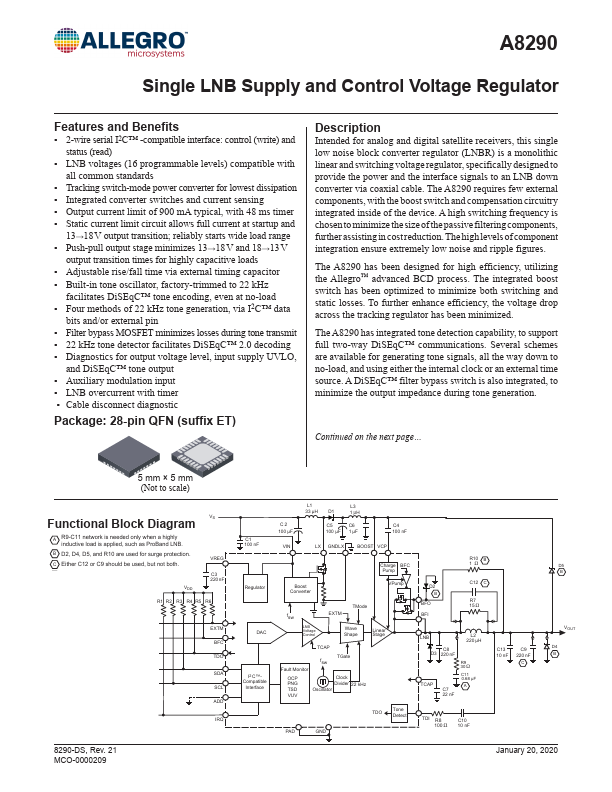
Intended for analog and digital satellite receivers, this single low noise block converter regulator (LNBR) is a monolithic linear and switching voltage regulator, specifically designed to provide the power and the interface signals to an LNB down converter via coaxial cable. The A8290 requires few external ponents, with the boost switch and pensation circuitry integrated inside of the device. A high switching frequency is chosen to minimize the size of the passive filtering ponents, further assisting in cost reduction. The high levels of ponent integration ensure extremely low noise and ripple figures.
The A8290 has been designed for high efficiency, utilizing the Allegro™ advanced BCD process. The integrated boost switch has been optimized to minimize both switching and static losses. To further enhance efficiency, the voltage drop...