• Part: A8904
  • Description: 3-PHASE BRUSHLESS DC MOTOR CONTROLLER/DRIVER
  • Manufacturer: Allegro MicroSystems
  • Size: 653.56 KB
Download A8904 Datasheet PDF
Allegro MicroSystems
A8904
A8904 is 3-PHASE BRUSHLESS DC MOTOR CONTROLLER/DRIVER manufactured by Allegro MicroSystems.
- Part of the A89 comparator family.
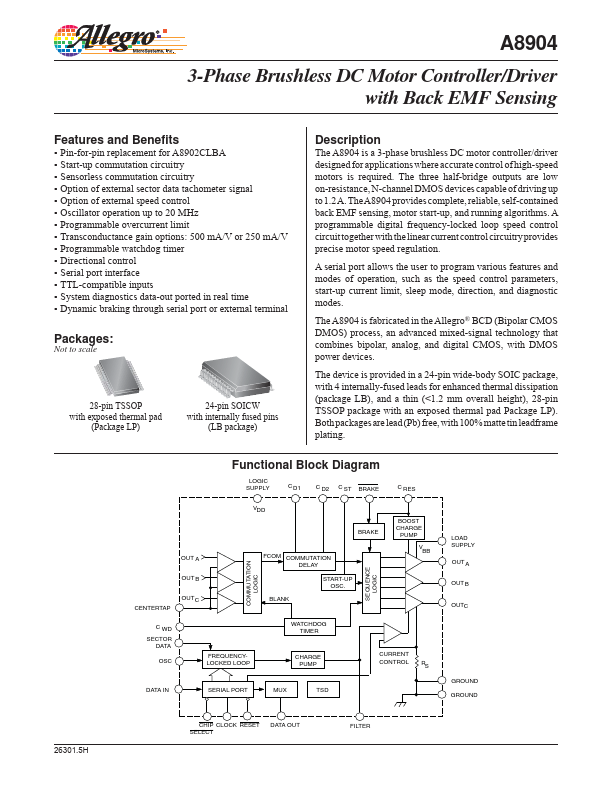
features and modes of operation, such as the speed control parameters, startup current limit, sleep mode, direction, and diagnostic modes. The A8904 is fabricated in Allegro’s BCD (Bipolar CMOS DMOS) process, an advanced mixed-signal technology that bines bipolar, analog and digital CMOS, and DMOS power devices. The A8904SLB is provided in a 24-lead wide-body SOIC batwing package. The A8904SLP is provided in a thin (<1.2 mm), 28-lead SSOP package with an exposed thermal pad. Each package type is available in a lead-free version (100% matte tin leadframe). Data Sheet 26301.5B Absolute Maximum Ratings Load Supply Voltage, VBB - - . . 15 V Output Current1, IOUT - - - - . ±1.4 A Peak Output Current (Brake)2, IOUT(BRK) . ±3.0 A Period2 for IOUT(BRK) to fall from ±3.0 A to ±1.4 A - - - 800 ms Logic Supply Voltage, VDD - - . 7.0 V Logic Input Voltage Range, VIN (continuous) - . -0.3 V to VDD + 0.3 V (tw <30 ns) - . . -1.0 V to VDD + 1.0 V Package Power Dissipation, PD . . See Graph Operating Temperature, TA . . . -20°C to +85°C Junction Temperature3, TJ - . . . . +150°C Storage Temperature,TS . . . . -55°C to +150°C 1Output Features - - - - - - - - - - - - - - Pin-for-pin replacement for A8902CLBA Startup mutation circuitry Sensorless mutation circuitry Option of external sector data tachometer signal Option of external speed control Oscillator operation up to 20 MHz Programmable overcurrent limit Transconductance gain options: 500 m A/V or 250 m A/V Programmable watchdog timer Directional control Serial Port Interface TTL-patible inputs System diagnostics data out ported in real time Dynamic braking through serial port or external terminal current rating may be restricted to a value determined by system concerns and factors. These include: system duty cycle and timing, ambient temperature, and use of any heatsinking and/or forced cooling. For reliable...