AD1671
AD1671 is Complete 12-Bit 1.25 MSPS Monolithic A/D Converter manufactured by Analog Devices.
- Part of the AD1 comparator family.
FEATURES
Conversion Time: 800 ns 1.25 MHz Throughput Rate plete: On-Chip Sample-and-Hold Amplifier and Voltage Reference Low Power Dissipation: 570 m W No Missing Codes Guaranteed Signal-to-Noise Plus Distortion Ratio f IN = 100 k Hz: 70 d B Pin Configurable Input Voltage Ranges Twos plement or Offset Binary Output Data 28-Pin DIP and 28-Pin Surface Mount Package Out of Range Indicator
AIN1 AIN2 plete 12-Bit 1.25 MSPS Monolithic A/D Converter AD1671
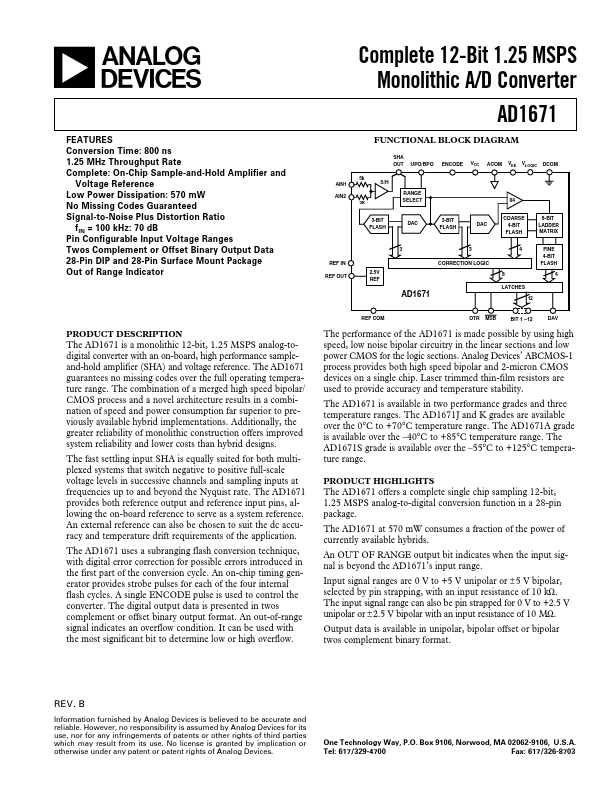
FUNCTIONAL BLOCK DIAGRAM
SHA OUT 5k UPO/BPO ENCODE VCC A VEE VLOGIC D S/H RANGE SELECT
5k
X4
3-BIT FLASH
3-BIT FLASH
COARSE 4-BIT FLASH 4
8-BIT LADDER MATRIX
3 REF IN REF OUT 2.5V REF
3 CORRECTION LOGIC 8
FINE 4-BIT FLASH 4
LATCHES
REF OTR MSB
BIT 1
- 12
PRODUCT DESCRIPTION
The AD1671 is a monolithic 12-bit, 1.25 MSPS analog-todigital converter with an on-board, high performance sampleand-hold amplifier (SHA) and voltage reference. The AD1671 guarantees no missing codes over the full operating temperature range. The bination of a merged high speed bipolar/ CMOS process and a novel architecture results in a bination of speed and power consumption far superior to previously available hybrid implementations. Additionally, the greater reliability of monolithic construction offers improved system reliability and lower costs than hybrid designs. The fast settling input SHA is equally suited for both multiplexed systems that switch negative to positive full-scale voltage levels in successive channels and sampling inputs at frequencies up to and beyond the Nyquist rate. The AD1671 provides both reference output and reference input pins, allowing the on-board reference to serve as a system reference. An external reference can also be chosen to suit the dc accuracy and temperature drift requirements of the application. The AD1671 uses a subranging flash conversion technique, with digital error correction for possible errors introduced in the first part of the conversion cycle. An on-chip...