AD53500
AD53500 is High Speed/ High Current Capability Pin Driver manufactured by Analog Devices.
a
Features
- 2 V to +6 V Output Range 2.5 ⍀ Output Resistance 2.5 ns Tr/Tf for a 3 V Step 300 MHz Toggle Rate Can Drive 25 ⍀ Lines and Lower Peak Dynamic Current Capability of 400 m A Inhibit Leakage <1 A On-Chip Temperature Sensor APPLICATIONS Automatic Test Equipment Semiconductor Test Systems Board Test Systems Instrumentation and Characterization Equipment
VH DATA DATA INH INH VL
High Speed, High Current Capability Pin Driver AD53500
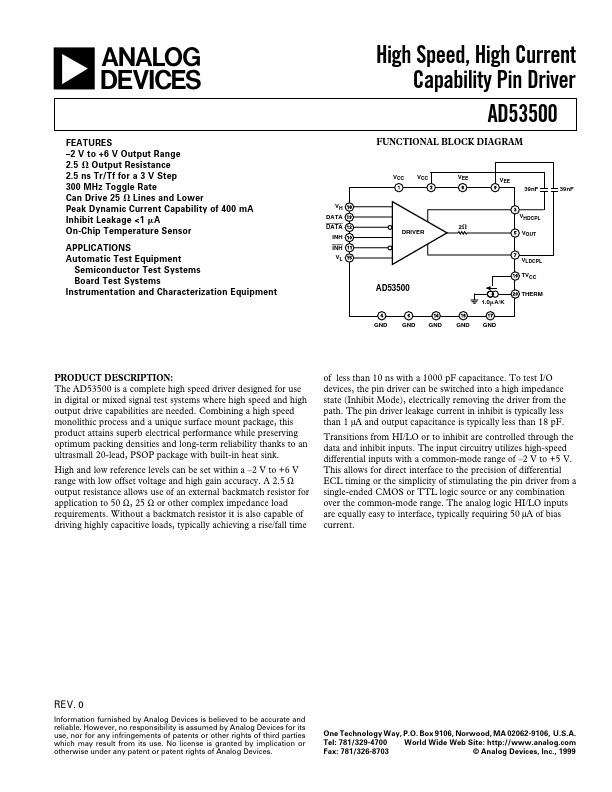
FUNCTIONAL BLOCK DIAGRAM
VCC VCC VEE VEE 39n F 39n F
VHDCPL DRIVER 2⍀ VOUT
VLDCPL TVCC
1.0A/K
THERM
PRODUCT DESCRIPTION:
The AD53500 is a plete high speed driver designed for use in digital or mixed signal test systems where high speed and high output drive capabilities are needed. bining a high speed monolithic process and a unique surface mount package, this product attains superb electrical performance while preserving optimum packing densities and long-term reliability thanks to an ultrasmall 20-lead, PSOP package with built-in heat sink. High and low reference levels can be set within a
- 2 V to +6 V range with low offset voltage and high gain accuracy. A 2.5 Ω output resistance allows use of an external backmatch resistor for application to 50 Ω, 25 Ω or other plex impedance load requirements. Without a backmatch resistor it is also capable of driving highly capacitive loads, typically achieving a rise/fall time of less than 10 ns with a 1000 p F capacitance. To test I/O devices, the pin driver can be switched into a high impedance state (Inhibit Mode), electrically removing the driver from the path. The pin driver leakage current in inhibit is typically less than 1 µA and output capacitance is typically less than 18 p F. Transitions from HI/LO or to inhibit are controlled through the data and inhibit inputs. The input circuitry utilizes high-speed differential inputs with a mon-mode range of
- 2 V to +5 V. This allows for direct interface to the precision of differential ECL...