ADIS16220
ADIS16220 is Programmable Digital Vibration Sensor manufactured by Analog Devices.
Programmable Digital Vibration Sensor
OBSOLETE
Features
Digital ±70 g accelerometer/vibration sensing 22 k Hz sensor resonance 100.2 k SPS sample rate SPI-patible serial interface Programmable data capture function:
3 channels, 1024 samples each 1 accelerometer/2 auxiliary ADCs (AIN1, AIN2)
Manual trigger for user initiation Automatic trigger for periodic data capture Event trigger for condition-driven capture Digital temperature sensor output Digitally controlled sample rate Digitally controlled frequency response 2 auxiliary digital I/Os Digitally activated self-test Digitally activated low power mode Serial number and device ID Single-supply operation: 3.15 V to 3.6 V Operating temperature range:
- 40°C to +125°C 9.2 mm × 9.2 mm 16-terminal LGA
APPLICATIONS
Vibration analysis Shock detection and event capture Condition monitoring Machine health Instrumentation, diagnostics Safety, shut-off sensing Security sensing, tamper detection
GENERAL DESCRIPTION
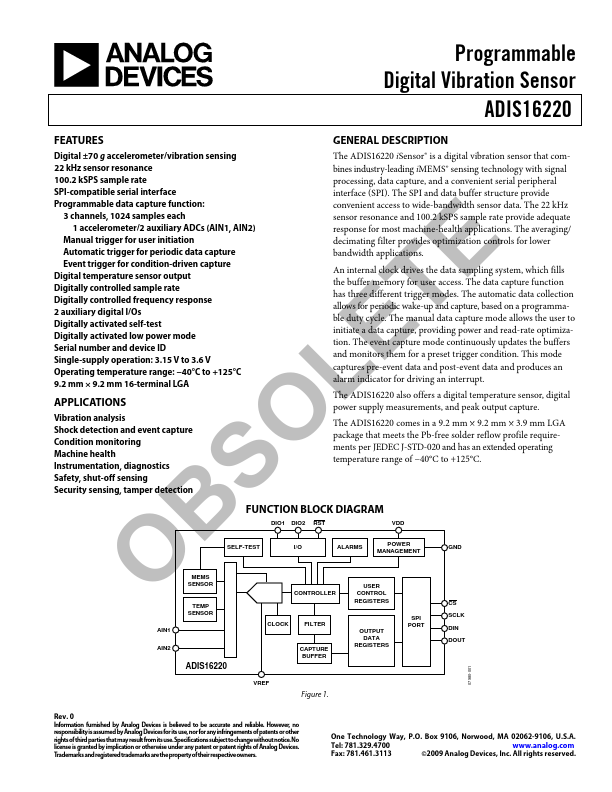
The ADIS16220 i Sensor® is a digital vibration sensor that bines industry-leading i MEMS® sensing technology with signal processing, data capture, and a convenient serial peripheral interface (SPI). The SPI and data buffer structure provide convenient access to wide-bandwidth sensor data. The 22 k Hz sensor resonance and 100.2 k SPS sample rate provide adequate response for most machine-health applications. The averaging/ decimating filter provides optimization controls for lower bandwidth applications.
An internal clock drives the data sampling system, which fills the buffer memory for user access. The data capture function has three different trigger modes. The automatic data collection allows for periodic wake-up and capture, based on a programmable duty cycle. The manual data capture mode allows the user to initiate a data capture, providing power and read-rate optimization. The event capture mode continuously updates the buffers and monitors them for a preset trigger condition. This mode captures...