ADIS16227
ADIS16227 is Digital Tri-Axial Vibration Sensor manufactured by Analog Devices.
Data Sheet
Features
Frequency domain triaxial vibration sensor Digital acceleration data, ± 70 g measurement range Digital range settings: 1 g, 5 g, 20 g, 70 g Sample rate: 100.2 k Hz, 4 decimation filter settings FFT, 512 point, real valued, all three axes (x, y, z) Windowing options: rectangular, Hanning, flat top Programmable FFT averaging, up to 256 averages Storage, 16 FFT records on all three axes (x, y, z) Programmable alarms, 6 spectral bands 2-level settings for warning and fault definition Adjustable response delay to reduce false alarms Trigger modes: SPI mand, timer, external trigger Multirecord capture for selected filter settings Manual capture mode for time-domain data collection Internal self-test with status flags Digital temperature and power supply measurements 2 auxiliary digital I/Os SPI-patible serial interface Serial number and device ID Single-supply operation: 3.15 V to 3.6 V Operating temperature range:
- 40°C to +125°C 15 mm × 15 mm × 15 mm aluminum package, flex connector
Digital Triaxial Vibration Sensor with FFT Analysis and Storage ADIS16227
GENERAL DESCRIPTION
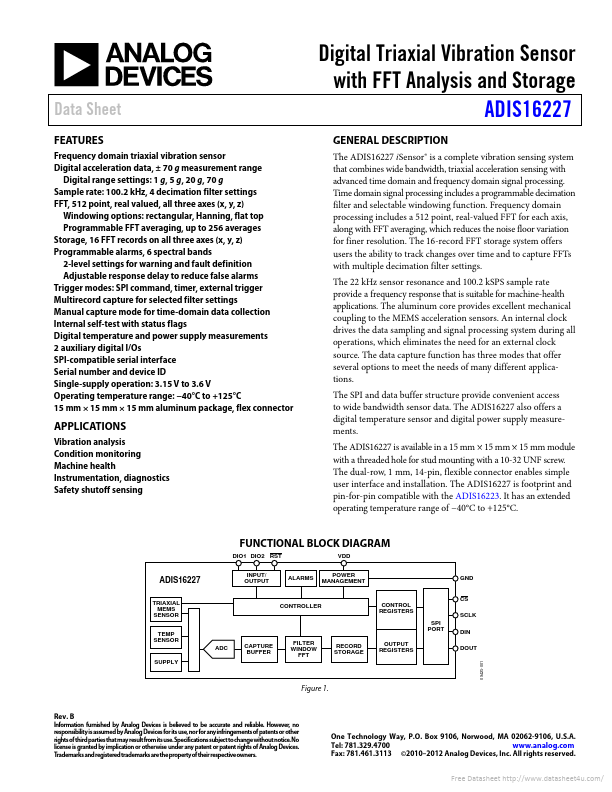
The ADIS16227 i Sensor® is a plete vibration sensing system that bines wide bandwidth, triaxial acceleration sensing with advanced time domain and frequency domain signal processing. Time domain signal processing includes a programmable decimation filter and selectable windowing function. Frequency domain processing includes a 512 point, real-valued FFT for each axis, along with FFT averaging, which reduces the noise floor variation for finer resolution. The 16-record FFT storage system offers users the ability to track changes over time and to capture FFTs with multiple decimation filter settings. The 22 k Hz sensor resonance and 100.2 k SPS sample rate provide a frequency response that is suitable for machine-health applications. The aluminum core provides excellent mechanical coupling to the MEMS acceleration sensors. An internal clock drives the data sampling and...