• Part: ADM2484E
  • Description: Isolated RS-485 Transceiver
  • Manufacturer: Analog Devices
  • Size: 601.21 KB
Download ADM2484E Datasheet PDF
Analog Devices
ADM2484E
ADM2484E is Isolated RS-485 Transceiver manufactured by Analog Devices.
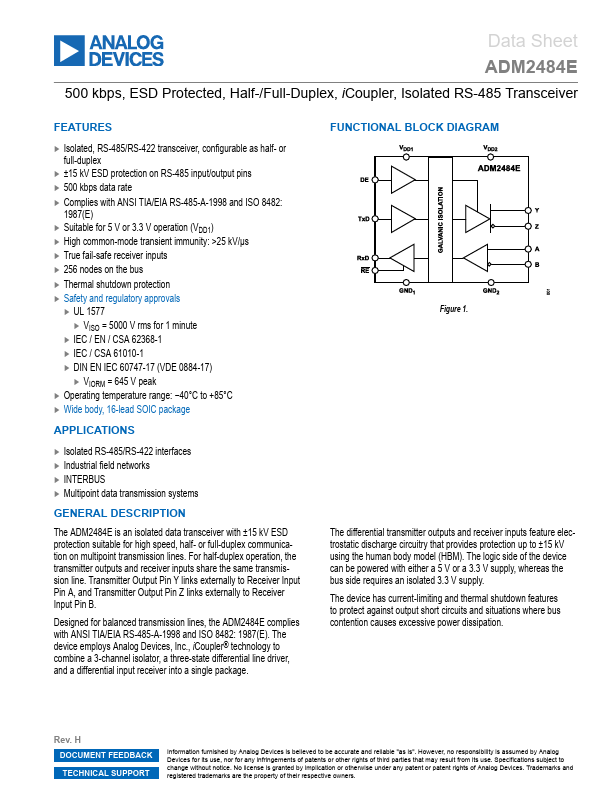
FEATURES - Isolated, RS-485/RS-422 transceiver, configurable as half- or full-duplex - ±15 k V ESD protection on RS-485 input/output pins - 500 kbps data rate - plies with ANSI TIA/EIA RS-485-A-1998 and ISO 8482: 1987(E) - Suitable for 5 V or 3.3 V operation (VDD1) - High mon-mode transient immunity: >25 k V/μs - True fail-safe receiver inputs - 256 nodes on the bus - Thermal shutdown protection - Safety and regulatory approvals - UL 1577 - VISO = 5000 V rms for 1 minute - IEC / EN / CSA 62368-1 - IEC / CSA 61010-1 - DIN EN IEC 60747-17 (VDE 0884-17) - VIORM = 645 V peak - Operating temperature range: - 40°C to +85°C - Wide body, 16-lead SOIC package APPLICATIONS - Isolated RS-485/RS-422 interfaces - Industrial field networks - INTERBUS - Multipoint data transmission systems GENERAL DESCRIPTION The ADM2484E is an isolated data transceiver with ±15 k V ESD protection suitable for high speed, half- or full-duplex munication on multipoint transmission lines. For half-duplex operation, the transmitter outputs and receiver inputs share the same transmission line. Transmitter Output Pin Y links externally to Receiver Input Pin A, and Transmitter Output Pin Z links externally to Receiver Input Pin B. Designed for balanced transmission lines, the ADM2484E plies with ANSI TIA/EIA RS-485-A-1998 and ISO 8482: 1987(E). The device employs Analog Devices, Inc., i Coupler® technology to bine a 3-channel isolator, a three-state differential line driver, and a differential input receiver into a single package. FUNCTIONAL BLOCK DIAGRAM Figure 1. The differential transmitter outputs and receiver inputs feature electrostatic discharge circuitry that provides protection up to ±15 k V using the human body model (HBM). The logic side of the device can be powered with either a 5 V or a 3.3 V supply, whereas the bus side requires an isolated 3.3 V supply. The device has current-limiting and thermal shutdown features to protect against output short circuits and situations where bus contention...