ADP3178
ADP3178 is 4-Bit Programmable Synchronous Buck Controllers manufactured by Analog Devices.
- Part of the ADP3158 comparator family.
- Part of the ADP3158 comparator family.
FEATURES
Optimally pensated Active Voltage Positioning with Gain and Offset Adjustment (ADOPT™) for Superior Load Transient Response plies with VRM Specifications with Lowest System Cost 4-Bit Digitally Programmable 1.3 V to 2.05 V Output N-Channel Synchronous Buck Driver Total Accuracy ؎0.8% Over Temperature Two On-Board Linear Regulator Controllers Designed to Meet System Power Sequencing Requirements High Efficiency Current-Mode Operation Short Circuit Protection for Switching Regulator Overvoltage Protection Crowbar Protects Microprocessors with No Additional External ponents
APPLICATIONS Core Supply Voltage Generation for:
Intel Pentium® III Intel Celeron™
4-Bit Programmable Synchronous Buck Controllers
ADP3158/ADP3178
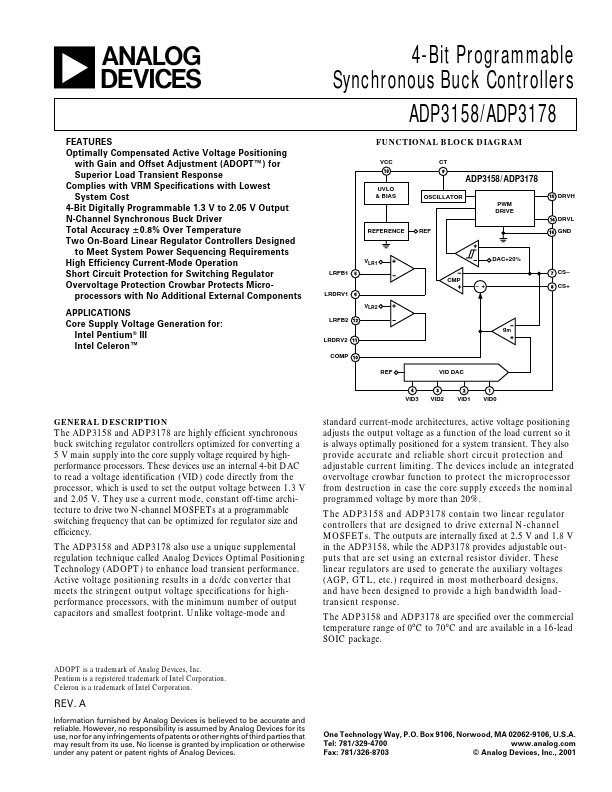
FUNCTIONAL BLOCK DIAGRAM
UVLO & BIAS
ADP3158/ ADP3178
OSCILLATOR
PWM DRIVE
REFERENCE REF
DRVH
DRVL GND
LRFB1
VLR1
LRDRV1 LRFB2
VLR2
LRDRV2 P
DAC+20%
- +
CS- CS+ gm
VID DAC
VID3 VID2 VID1 VID0
GENERAL DESCRIPTION
The ADP3158 and ADP3178 are highly efficient synchronous buck switching regulator controllers optimized for converting a 5 V main supply into the core supply voltage required by highperformance processors. These devices use an internal 4-bit DAC to read a voltage identification (VID) code directly from the processor, which is used to set the output voltage between 1.3 V and 2.05 V. They use a current mode, constant off-time architecture to drive two N-channel MOSFETs at a programmable switching frequency that can be optimized for regulator size and efficiency.
The ADP3158 and ADP3178 also use a unique supplemental regulation technique called Analog Devices Optimal Positioning Technology (ADOPT) to enhance load transient performance. Active voltage positioning results in a dc/dc converter that meets the stringent output voltage specifications for highperformance processors, with the minimum number of output capacitors and smallest footprint. Unlike voltage-mode and standard current-mode architectures,...