• Part: TMP12
  • Description: Airflow and Temperature Sensor
  • Manufacturer: Analog Devices
  • Size: 446.27 KB
Download TMP12 Datasheet PDF
Analog Devices
TMP12
TMP12 is Airflow and Temperature Sensor manufactured by Analog Devices.
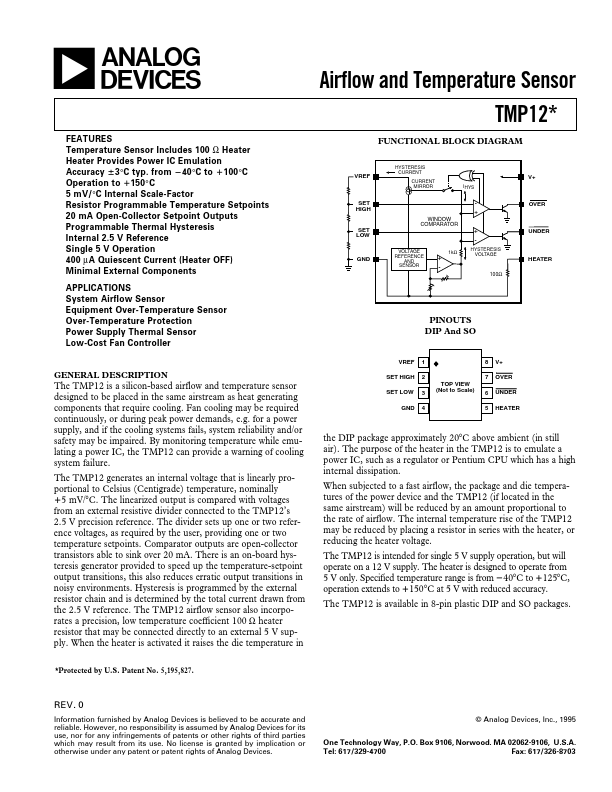
FEATURES Temperature Sensor Includes 100 Ω Heater Heater Provides Power IC Emulation Accuracy ؎ 3°C typ. from ؊ 40°C to ؉ 100°C Operation to ؉150° C 5 m V/ °C Internal Scale-Factor Resistor Programmable Temperature Setpoints 20 m A Open-Collector Setpoint Outputs Programmable Thermal Hysteresis Internal 2.5 V Reference Single 5 V Operation 400 µ A Quiescent Current (Heater OFF) Minimal External ponents APPLICATIONS System Airflow Sensor Equipment Over-Temperature Sensor Over-Temperature Protection Power Supply Thermal Sensor Low-Cost Fan Controller Airflow and Temperature Sensor TMP12- FUNCTIONAL BLOCK DIAGRAM HYSTERESIS CURRENT CURRENT MIRROR IHYS VREF V+ SET HIGH WINDOW PARATOR + + - OVER SET LOW VOLTAGE REFERENCE AND SENSOR 1kΩ UNDER HYSTERESIS VOLTAGE PINOUTS DIP And SO VREF 1 2 3 4 TOP VIEW (Not to Scale) GENERAL DESCRIPTION SET HIGH SET LOW GND The TMP12 is a silicon-based airflow and temperature sensor designed to be placed in the same airstream as heat generating ponents that require cooling. Fan cooling may be required continuously, or during peak power demands, e.g. for a power supply, and if the cooling systems fails, system reliability and/or safety may be impaired. By monitoring temperature while emulating a power IC, the TMP12 can provide a warning of cooling system failure. The TMP12 generates an internal voltage that is linearly proportional to Celsius (Centigrade) temperature, nominally ؉5 m V/°C. The linearized output is pared with voltages from an external resistive divider connected to the TMP12’s 2.5 V precision reference. The divider sets up one or two reference voltages, as required by the user, providing one or two temperature setpoints. parator outputs are open-collector transistors able to sink over 20 m A. There is an on-board hysteresis generator provided to speed up the temperature-setpoint output transitions, this also reduces erratic output transitions in noisy environments. Hysteresis is programmed by the external...