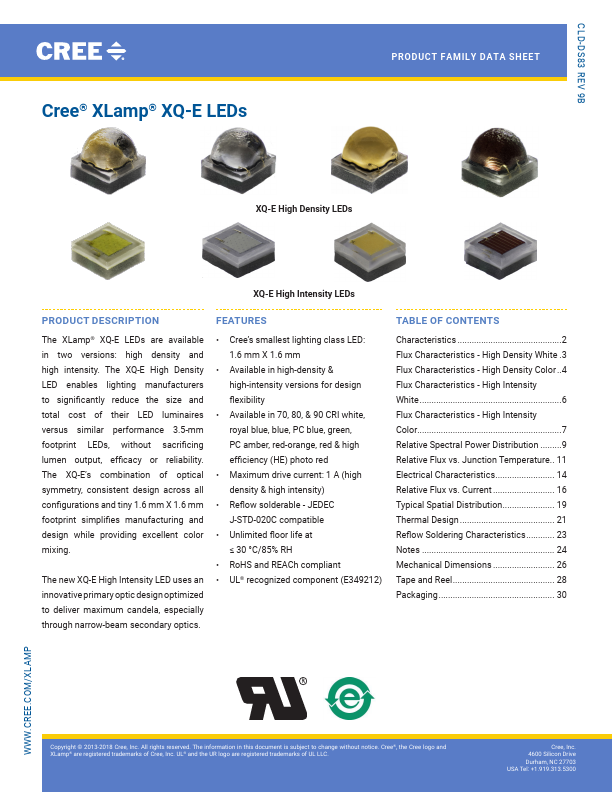
• Part: XQEEPR
  • Description: LED
  • Manufacturer: Cree
  • Size: 2.46 MB
Download XQEEPR Datasheet PDF
Cree
XQEEPR
XQEEPR is LED manufactured by Cree.
- Part of the XQEAWT comparator family.
SCRIPTION The XLamp® XQ-E LEDs are available in two versions: high density and high intensity. The XQ-E High Density LED enables lighting manufacturers to significantly reduce the size and total cost of their LED luminaires versus similar performance 3.5‑mm footprint LEDs, without sacrificing lumen output, efficacy or reliability. The XQ-E’s bination of optical symmetry, consistent design across all configurations and tiny 1.6 mm X 1.6 mm footprint simplifies manufacturing and design while providing excellent color mixing. The new XQ-E High Intensity LED uses an innovative primary optic design optimized to deliver maximum candela, especially through narrow‑beam secondary optics. Features - Cree’s smallest lighting class LED: 1.6 mm X 1.6 mm - Available in high‑density & high‑intensity versions for design flexibility - Available in 70, 80, & 90 CRI white, royal blue, blue, PC blue, green, PC amber, red‑orange, red & high efficiency (HE) photo red - Maximum drive current: 1 A (high density & high intensity) - Reflow solderable - JEDEC J-STD‑020C patible - Unlimited floor life at ≤ 30 °C/85% RH - Ro HS and REACh pliant - UL® recognized ponent (E349212) TABLE OF CONTENTS Characteristics.............................................2 Flux Characteristics - High Density White..3 Flux Characteristics - High Density Color...4 Flux Characteristics - High Intensity White.............................................................6 Flux Characteristics - High Intensity Color.............................................................7 Relative Spectral Power Distribution..........9 Relative Flux vs. Junction Temperature... 11 Electrical Characteristics.......................... 14 Relative Flux vs. Current........................... 16 Typical Spatial Distribution....................... 19 Thermal Design......................................... 21 Reflow Soldering Characteristics............. 23 Notes......................................................... 24...