CS625
CS625 is Water Content Relflectometer manufactured by Campbell Scientic.
CS625 Water Content Reflectometer for CR200(X)-Series Loggers
The CS625 Water Content Reflectometer measures the volumetric water content of porous media using time-domain measurement methods that are sensitive to dielectric permittivity. The probe consists of two 30 cm long stainless steel rods connected to a printed circuit board. The circuit board is encapsulated in epoxy, and a shielded four-conductor cable is connected to the circuit board to supply power, enable probe, and monitor the output. The probe rods can be inserted from the surface or the probe can be buried at any orientation to the surface. The CS625 has been developed specifically for the CR200(X)-series dataloggers and is not patible with other dataloggers. Another reflectometer, the CS616, can be used with a CR510, CR800, CR850, CR10X, CR1000, CR3000, or CR5000 datalogger. The CS625 connects directly to one of the datalogger’s single-ended analog inputs. A datalogger control port is used to enable the CS625 for the amount of time required to make the measurement. Datalogger instructions convert the probe square-wave output to period which is converted to volumetric water content using a calibration. Note: A maximum of four CS625 probes can be measured by one CR200(X) datalogger. Valid channel options are analog channels 1 through 4.
5 62 CS
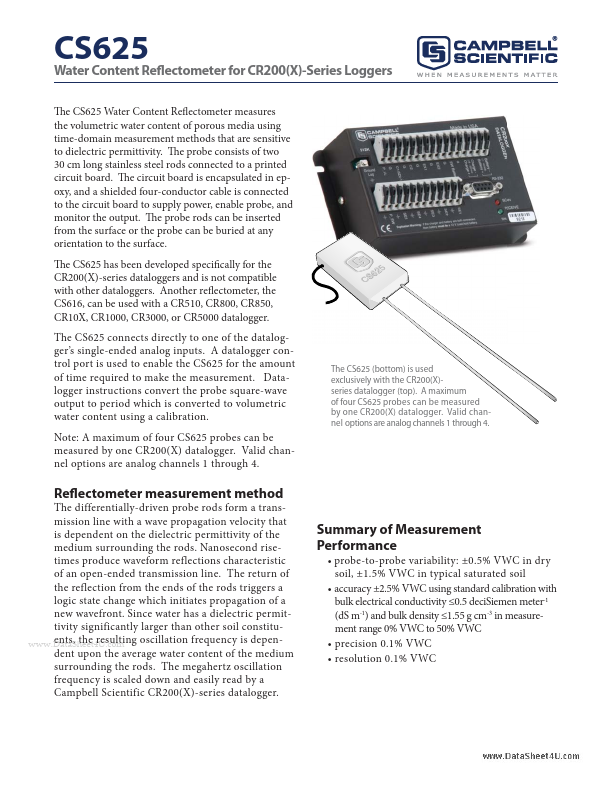
The CS625 (bottom) is used exclusively with the CR200(X)series datalogger (top). A maximum of four CS625 probes can be measured by one CR200(X) datalogger. Valid channel options are analog channels 1 through 4.
Reflectometer measurement method
The differentially-driven probe rods form a transmission line with a wave propagation velocity that is dependent on the dielectric permittivity of the medium surrounding the rods. Nanosecond risetimes produce waveform reflections characteristic of an open-ended transmission line. The return of the reflection from the ends of the rods triggers a logic state change which initiates propagation of a new wavefront. Since...