CY7C1529KV18
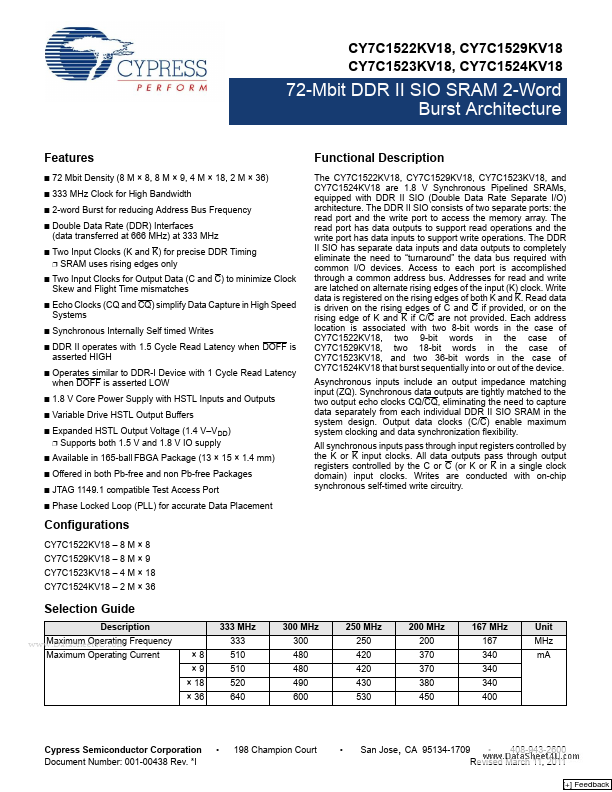
CY7C1529KV18 is 72-Mbit DDR II SIO SRAM 2-Word Burst Architecture manufactured by Cypress.
- Part of the CY7C1522KV18 comparator family.
- Part of the CY7C1522KV18 comparator family.
CY7C1522KV18, CY7C1529KV18 CY7C1523KV18, CY7C1524KV18
72-Mbit DDR II SIO SRAM 2-Word Burst Architecture
72-Mbit DDR II SIO SRAM 2-Word Burst Architecture
Features
- -
- -
- Functional Description
The CY7C1522KV18, CY7C1529KV18, CY7C1523KV18, and CY7C1524KV18 are 1.8 V Synchronous Pipelined SRAMs, equipped with DDR II SIO (Double Data Rate Separate I/O) architecture. The DDR II SIO consists of two separate ports: the read port and the write port to access the memory array. The read port has data outputs to support read operations and the write port has data inputs to support write operations. The DDR II SIO has separate data inputs and data outputs to pletely eliminate the need to “turnaround” the data bus required with mon I/O devices. Access to each port is acplished through a mon address bus. Addresses for read and write are latched on alternate rising edges of the input (K) clock. Write data is registered on the rising edges of both K and K. Read data is driven on the rising edges of C and C if provided, or on the rising edge of K and K if C/C are not provided. Each address location is associated with two 8-bit words in the case of CY7C1522KV18, two 9-bit words in the case of CY7C1529KV18, two 18-bit words in the case of CY7C1523KV18, and two 36-bit words in the case of CY7C1524KV18 that burst sequentially into or out of the device. Asynchronous inputs include an output impedance matching input (ZQ). Synchronous data outputs are tightly matched to the two output echo clocks CQ/CQ, eliminating the need to capture data separately from each individual DDR II SIO SRAM in the system design. Output data clocks (C/C) enable maximum system clocking and data synchronization flexibility. All synchronous inputs pass through input registers controlled by the K or K input clocks. All data outputs pass through output registers controlled by the C or C (or K or K in a single clock domain) input clocks. Writes are conducted with on-chip synchronous self-timed...