Datasheet4U Logo Datasheet4U.com

EM4022 - Multi Frequency Contactless Identification Device Anti-Collision compatible

Download the EM4022 datasheet PDF. This datasheet also covers the EM4022_EMMicroelectronic variant, as both devices belong to the same multi frequency contactless identification device anti-collision compatible family and are provided as variant models within a single manufacturer datasheet.

General Description

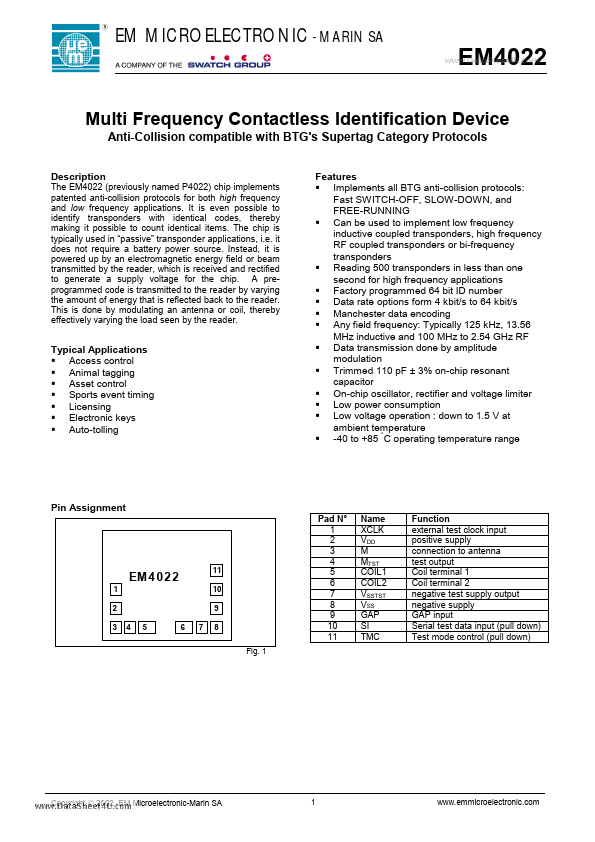
The EM4022 (previously named P4022) chip implements patented anti-collision protocols for both high frequency and low frequency applications.

It is even possible to identify transponders with identical codes, thereby making it possible to count identical items.
Key Features

  • Implements all BTG anti-collision protocols: Fast SWITCH-OFF, SLOW-DOWN, and FREE-.

📥 Download Datasheet

Note: The manufacturer provides a single datasheet file (EM4022_EMMicroelectronic-MARINSA.pdf) that lists specifications for multiple related part numbers.

Datasheet Details

Part number EM4022
Manufacturer EM Microelectronic - MARIN SA
File Size 309.24 KB
Description Multi Frequency Contactless Identification Device Anti-Collision compatible
Datasheet download datasheet EM4022 Datasheet

Full PDF Text Transcription (Reference)

The following content is an automatically extracted verbatim text from the original manufacturer datasheet and is provided for reference purposes only.

View original datasheet text
EM MICROELECTRONIC - MARIN SA www.DataSheet4U.com EM4022 Multi Frequency Contactless Identification Device Anti-Collision compatible with BTG's Supertag Category Protocols Description The EM4022 (previously named P4022) chip implements patented anti-collision protocols for both high frequency and low frequency applications. It is even possible to identify transponders with identical codes, thereby making it possible to count identical items. The chip is typically used in “passive” transponder applications, i.e. it does not require a battery power source. Instead, it is powered up by an electromagnetic energy field or beam transmitted by the reader, which is received and rectified to generate a supply voltage for the chip.