Datasheet4U Logo Datasheet4U.com

EM4550 - 1-KBit Read/Write Contactless Identification Device

Download the EM4550 datasheet PDF. This datasheet also covers the EM4450 variant, as both devices belong to the same 1-kbit read/write contactless identification device family and are provided as variant models within a single manufacturer datasheet.

Description

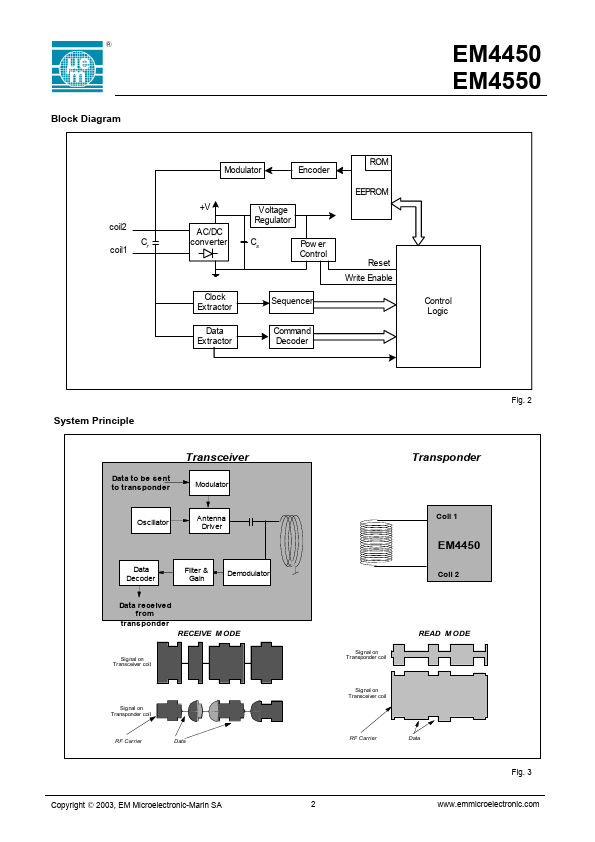
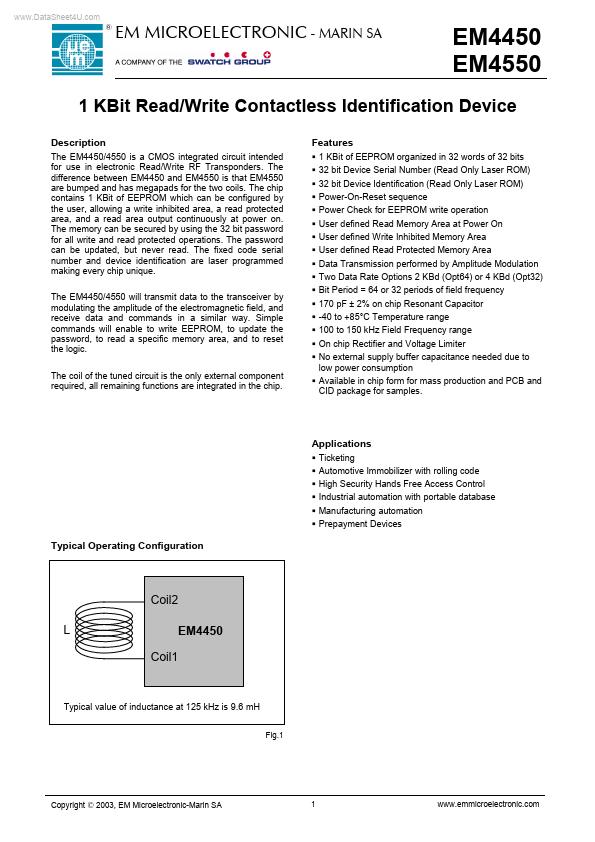
The EM4450/4550 is a CMOS integrated circuit intended for use in electronic Read/Write RF Transponders.

The difference between EM4450 and EM4550 is that EM4550 are bumped and has megapads for the two coils.

Features

  • 1 KBit of EEPROM organized in 32 words of 32 bits 32 bit Device Serial Number (Read Only Laser ROM) 32 bit Device Identification (Read Only Laser ROM) Power-On-Reset sequence Power Check for EEPROM write operation User defined Read Memory Area at Power On User defined Write Inhibited Memory Area User defined Read Protected Memory Area Data Transmission performed by Amplitude Modulation Two Data Rate Options 2 KBd (Opt64) or 4 KBd (Opt32) Bit Period = 64 or 32 periods of field frequency 170 pF ±.

📥 Download Datasheet

Note: The manufacturer provides a single datasheet file (EM4450_EMMicroelectronic.pdf) that lists specifications for multiple related part numbers.

Datasheet Details

Part number EM4550
Manufacturer EM Microelectronic
File Size 259.47 KB
Description 1-KBit Read/Write Contactless Identification Device
Datasheet download datasheet EM4550 Datasheet

Full PDF Text Transcription

Click to expand full text
www.DataSheet4U.com EM MICROELECTRONIC - MARIN SA EM4450 EM4550 1 KBit Read/Write Contactless Identification Device Description The EM4450/4550 is a CMOS integrated circuit intended for use in electronic Read/Write RF Transponders. The difference between EM4450 and EM4550 is that EM4550 are bumped and has megapads for the two coils. The chip contains 1 KBit of EEPROM which can be configured by the user, allowing a write inhibited area, a read protected area, and a read area output continuously at power on. The memory can be secured by using the 32 bit password for all write and read protected operations. The password can be updated, but never read. The fixed code serial number and device identification are laser programmed making every chip unique.

Published: |