ETA6937
ETA6937 is 12V/3A Switching Li+ Battery Charger and 5V/1A OTG manufactured by ETA.
12V/3A Switching Li+Battery Charger and 5V/1A OTG with I2C Control
DESCRIPTION
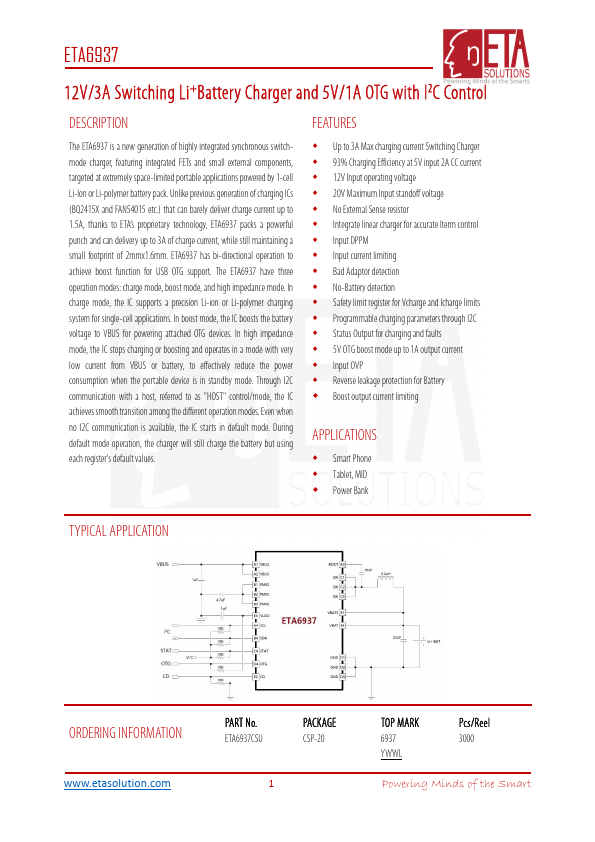
The ETA6937 is a new generation of highly integrated synchronous switchmode charger, featuring integrated FETs and small external ponents, targeted at extremely space-limited portable applications powered by 1-cell Li-Ion or Li-polymer battery pack. Unlike previous generation of charging ICs (BQ2415X and FAN54015 etc.) that can barely deliver charge current up to 1.5A, thanks to ETA’s proprietary technology, ETA6937 packs a powerful punch and can delivery up to 3A of charge current, while still maintaining a small footprint of 2mmx1.6mm. ETA6937 has bi-directional operation to achieve boost function for USB OTG support. The ETA6937 have three operation modes: charge mode, boost mode, and high impedance mode. In charge mode, the IC supports a precision Li-ion or Li-polymer charging system for single-cell applications. In boost mode, the IC boosts the battery voltage to VBUS for powering attached OTG devices. In high impedance mode, the IC stops charging or boosting and operates in a mode with very low current from VBUS or battery, to effectively reduce the power consumption when the portable device is in standby mode. Through I2C munication with a host, referred to as "HOST" control/mode, the IC achieves smooth transition among the different operation modes. Even when no I2C munication is available, the IC starts in default mode. During default mode operation, the charger will still charge the battery but using each register's default values.
Features
Up to 3A Max charging current Switching Charger 93% Charging Efficiency at 5V input 2A CC current 12V Input operating voltage 20V Maximum Input standoff voltage No External Sense resistor Integrate linear charger for accurate Iterm control Input DPPM Input current limiting Bad Adaptor detection No-Battery detection Safety limit register for Vcharge and Icharge limits Programmable charging parameters through I2C Status...