Datasheet4U Logo Datasheet4U.com

SMP9317 - Nonvolatile DACPOT Electronic Potentiometer With Up/Down Counter Interface

General Description

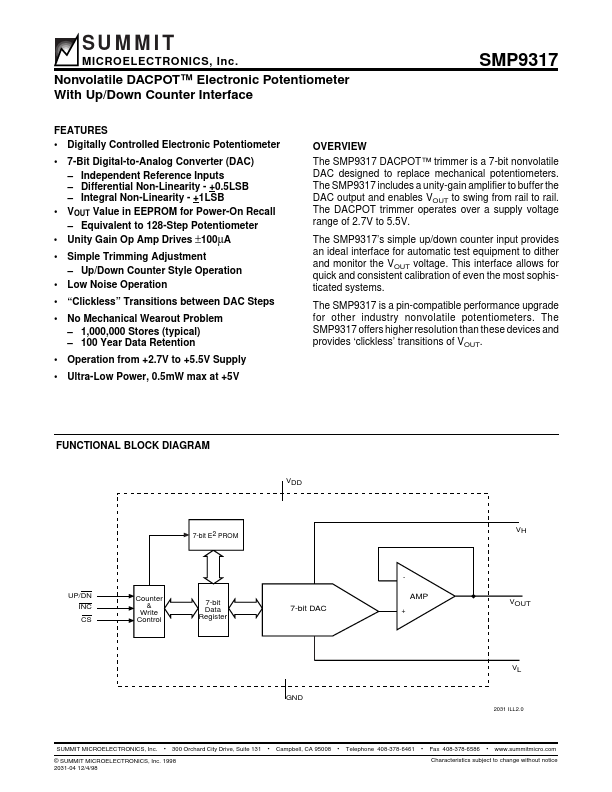
Increment Input, High to Low Edge Trigger Up/Down Input controlling relative VOUT movement V+ reference input Analog and Digital Ground Trimmed Voltage Output V- reference input Active low chip select input Supply Voltage (2.7V to 5.5V) Increment (INC) is an edge triggered input.

Key Features

  • Digitally Controlled Electronic Potentiometer.
  • 7-Bit Digital-to-Analog Converter (DAC).
  • Independent Reference Inputs.
  • Differential Non-Linearity - +0.5LSB.
  • Integral Non-Linearity - +1LSB.
  • VOUT Value in EEPROM for Power-On Recall.
  • Equivalent to 128-Step Potentiometer.
  • Unity Gain Op Amp Drives ±100µA.
  • Simple Trimming Adjustment.
  • Up/Down Counter Style Operation.
  • Low Noise Operation.
  • “Clickle.

📥 Download Datasheet

Datasheet Details

Part number SMP9317
Manufacturer Unknown Manufacturer
File Size 38.41 KB
Description Nonvolatile DACPOT Electronic Potentiometer With Up/Down Counter Interface
Datasheet download datasheet SMP9317 Datasheet

Full PDF Text Transcription (Reference)

The following content is an automatically extracted verbatim text from the original manufacturer datasheet and is provided for reference purposes only.

View original datasheet text
SUMMIT MICROELECTRONICS, Inc. SMP9317 Nonvolatile DACPOT™ Electronic Potentiometer With Up/Down Counter Interface FEATURES • Digitally Controlled Electronic Potentiometer • 7-Bit Digital-to-Analog Converter (DAC) – Independent Reference Inputs – Differential Non-Linearity - +0.5LSB – Integral Non-Linearity - +1LSB • VOUT Value in EEPROM for Power-On Recall – Equivalent to 128-Step Potentiometer • Unity Gain Op Amp Drives ±100µA • Simple Trimming Adjustment – Up/Down Counter Style Operation • Low Noise Operation • “Clickless” Transitions between DAC Steps • No Mechanical Wearout Problem – 1,000,000 Stores (typical) – 100 Year Data Retention • Operation from +2.7V to +5.5V Supply • Ultra-Low Power, 0.