XR16V2650
XR16V2650 is HIGH PERFORMANCE DUART manufactured by Exar.
DESCRIPTION
The XR16V26501 (V2650) is a high performance dual universal asynchronous receiver and transmitter (UART) with 32 bytes TX and RX FIFOs. The device operates from 2.25 to 3.6 volts with 5 Volt tolerant inputs and is pin-to-pin patible to Exar’s ST16C2550, XR16C2550 and XR16V2550. The V2650 register set is patible to the ST16C2550, the XR16L2550 and the XR16V2550. It supports Exar’s enhanced features of selectable FIFO trigger level, automatic hardware (RTS/CTS) and software flow control, and a plete modem interface. Onboard registers provide the user with operational status and data error flags. An internal loopback capability allows system diagnostics. Independent programmable baud rate generators are provided in each channel to select data rates up to 16 Mbps at 3.3 Volt with 4X sampling clock. The V2650 is available in 48-pin TQFP and 32-pin QFN packages.
NOTE: 1 Covered by U.S. Patent #5,649,122
FEATURES
- 2.25 to 3.6 Volt Operation
- 5 Volt Tolerant Inputs
- Pin-to-pin patible to ST16C2550, XR16C2550,
XR16L2550 and XR16V2550 in the 48-TQFP package
- Two independent UART channels
- -
Register set patible to XR16V2550 Data rate of up to 16 Mbps at 3.3 V, and 12.5 Mbps at 2.5 V with 4X sampling rate Fractional Baud Rate Generator Transmit and Receive FIFOs of 32 bytes Selectable TX and RX FIFO Trigger Levels Automatic Hardware (RTS/CTS) Flow Control Automatic Software (Xon/Xoff) Flow Control Wireless Infrared (Ir DA 1.0) Encoder/Decoder Automatic sleep mode Full modem interface
- -
- -
- -
- -
APPLICATIONS
- Portable Appliances
- Telemunication Network Routers
- Ethernet Network Routers
- Cellular Data Devices
- Factory Automation and Process Controls
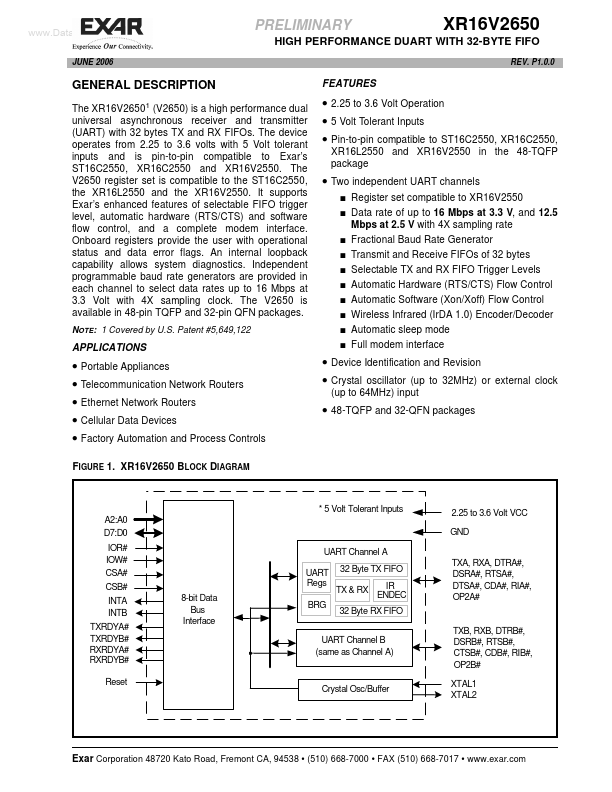
FIGURE 1. XR16V2650 BLOCK DIAGRAM
- Device Identification and Revision
- Crystal oscillator (up to 32MHz) or external clock
(up to 64MHz) input
- 48-TQFP and 32-QFN packages
- 5 Volt Tolerant Inputs A2:A0 D7:D0 IOR# IOW# CSA# CSB# INTA INTB TXRDYA# TXRDYB# RXRDYA# RXRDYB# Reset 8-bit Data Bus...