74LCX16245
74LCX16245 is Low Voltage 16-Bit Bidirectional Transceiver manufactured by Fairchild Semiconductor.
74LCX16245 Low Voltage 16-Bit Bidirectional Transceiver with 5V Tolerant Inputs and Outputs
February 1994 Revised April 2000
74LCX16245 Low Voltage 16-Bit Bidirectional Transceiver with 5V Tolerant Inputs and Outputs
General Description
The LCX16245 contains sixteen non-inverting bidirectional buffers with 3-STATE outputs and is intended for bus oriented applications. The device is designed for low voltage (2.5V or 3.3V) VCC applications with capability of interfacing to a 5V signal environment. The device is byte controlled. Each byte has separate control inputs which could be shorted together for full 16-bit operation. The T/R inputs determine the direction of data flow through the device. The OE inputs disable both the A and B ports by placing them in a high impedance state. The LCX16245 is fabricated with an advanced CMOS technology to achieve high speed operation while maintaining CMOS low power dissipation.
Features s 5V tolerant inputs and outputs s 2.3V- 3.6V VCC specifications provided s 4.5 ns t PD max (VCC = 3.3V), 20 µA ICC max s Power down high impedance inputs and outputs s Supports live insertion/withdrawal (Note 1) s ±24 m A output drive (VCC = 3.0V) s Implements patented noise/EMI reduction circuitry s Latch-up performance exceeds 500 m A s ESD performance: Human body model > 2000V Machine model > 200V
Note 1: To ensure the high-impedance state during power up or down, OE should be tied to VCC through a pull-up resistor: the minimum value or the resistor is determined by the current-sourcing capability of the driver.
Ordering Code:
Order Number 74LCX16245MEA 74LCX16245MTD Package Number MS48A MTD48 Package Description 48-Lead Small Shrink Outline Package (SSOP), JEDEC MO-118, 0.300” Wide 48-Lead Thin Shrink Small Outline Package (TSSOP), JEDEC MO-153, 6.1mm Wide
Devices also available in Tape and Reel. Specify by appending the suffix letter “X” to the ordering code.
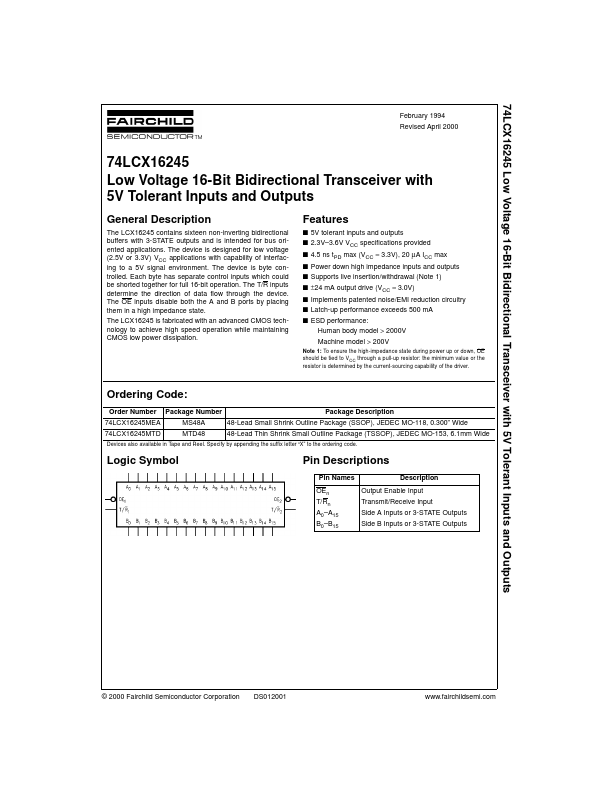
Logic Symbol
Pin Descriptions
Pin Names OEn T/Rn A0- A15 B0- B15 Description...