Datasheet4U Logo Datasheet4U.com

RFD16N03LSM - Enhancement-Mode Power MOSFET

Download the RFD16N03LSM datasheet PDF. This datasheet also covers the RFD16N03L variant, as both devices belong to the same enhancement-mode power mosfet family and are provided as variant models within a single manufacturer datasheet.

General Description

The RFD16N03L and RFD16N03LSM are N-channel power MOSFETs manufactured using the MegaFET process.

This process, which uses feature sizes approaching those of LSI circuits, gives optimum utilization of silicon, resulting in outstanding performance.

Key Features

  • Packaging.
  • 16A, 30V.
  • rDS(ON) = 0.022Ω.
  • Temperature Compensating PSPICE Model.
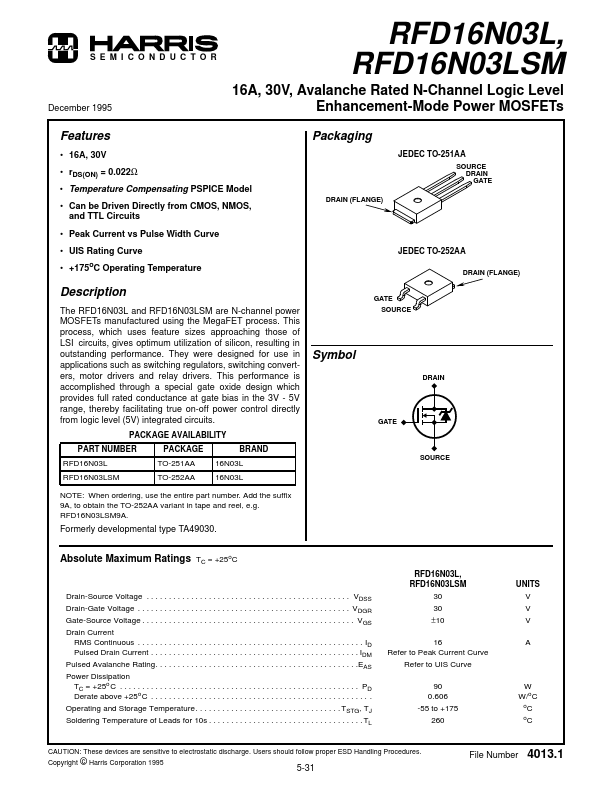
  • Can be Driven Directly from CMOS, NMOS, and TTL Circuits DRAIN (FLANGE) JEDEC TO-251AA SOURCE DRAIN GATE.
  • Peak Current vs Pulse Width Curve.
  • UIS Rating Curve.
  • +175oC Operating Temperature JEDEC TO-252AA DRAIN (FLANGE).

📥 Download Datasheet

Note: The manufacturer provides a single datasheet file (RFD16N03L-Harris.pdf) that lists specifications for multiple related part numbers.

Datasheet Details

Part number RFD16N03LSM
Manufacturer Harris
File Size 130.03 KB
Description Enhancement-Mode Power MOSFET
Datasheet download datasheet RFD16N03LSM Datasheet

Full PDF Text Transcription (Reference)

The following content is an automatically extracted verbatim text from the original manufacturer datasheet and is provided for reference purposes only.

View original datasheet text
SEMICONDUCTOR RFD16N03L, RFD16N03LSM December 1995 16A, 30V, Avalanche Rated N-Channel Logic Level Enhancement-Mode Power MOSFETs Features Packaging • 16A, 30V • rDS(ON) = 0.022Ω • Temperature Compensating PSPICE Model • Can be Driven Directly from CMOS, NMOS, and TTL Circuits DRAIN (FLANGE) JEDEC TO-251AA SOURCE DRAIN GATE • Peak Current vs Pulse Width Curve • UIS Rating Curve • +175oC Operating Temperature JEDEC TO-252AA DRAIN (FLANGE) Description The RFD16N03L and RFD16N03LSM are N-channel power MOSFETs manufactured using the MegaFET process. This process, which uses feature sizes approaching those of LSI circuits, gives optimum utilization of silicon, resulting in outstanding performance.