IDT74ALVCH16652
IDT74ALVCH16652 is CMOS 16-BIT BUS TRANSCEIVER AND REGISTER manufactured by IDT.
..
IDT74ALVCH16652 3.3V CMOS 16-BIT BUS TRANSCEIVER AND REGISTER
INDUSTRIAL TEMPERATURE RANGE
3.3V CMOS 16-BIT BUS TRANSCEIVER AND REGISTER WITH 3-STATE OUTPUTS AND BUS-HOLD
- 0.5 MICRON CMOS Technology
- Typical t SK(o) (Output Skew) < 250ps
- ESD > 2000V per MIL-STD-883, Method 3015; > 200V using machine model (C = 200p F, R = 0)
- VCC = 3.3V ± 0.3V, Normal Range
- VCC = 2.7V to 3.6V, Extended Range
- VCC = 2.5V ± 0.2V
- CMOS power levels (0.4µ W typ. static)
- Rail-to-Rail output swing for increased noise margin
- Available in TSSOP package
Features
:
DESCRIPTION:
DRIVE Features
:
- High Output Drivers: ±24m A
- Suitable for heavy loads
APPLICATIONS:
- 3.3V high speed systems
- 3.3V and lower voltage puting systems
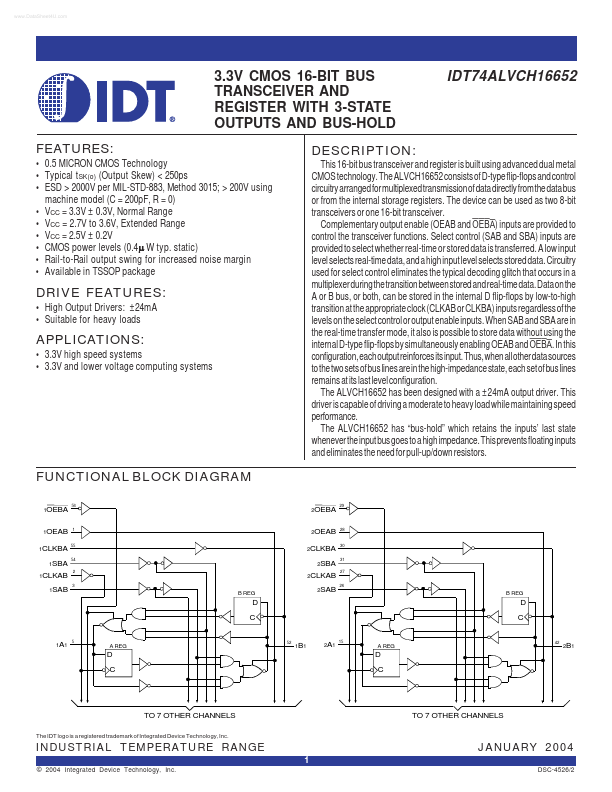
This 16-bit bus transceiver and register is built using advanced dual metal CMOS technology. The ALVCH16652 consists of D-type flip-flops and control circuitry arranged for multiplexed transmission of data directly from the data bus or from the internal storage registers. The device can be used as two 8-bit transceivers or one 16-bit transceiver. plementary output enable (OEAB and OEBA) inputs are provided to control the transceiver functions. Select control (SAB and SBA) inputs are provided to select whether real-time or stored data is transferred. A low input level selects real-time data, and a high input level selects stored data. Circuitry used for select control eliminates the typical decoding glitch that occurs in a multiplexer during the transition between stored and real-time data. Data on the A or B bus, or both, can be stored in the internal D flip-flops by low-to-high transition at the appropriate clock (CLKAB or CLKBA) inputs regardless of the levels on the select control or output enable inputs. When SAB and SBA are in the real-time transfer mode, it also is possible to store data without using the internal D-type flip-flops by simultaneously enabling OEAB and OEBA. In this configuration, each...