MEE95-06DA
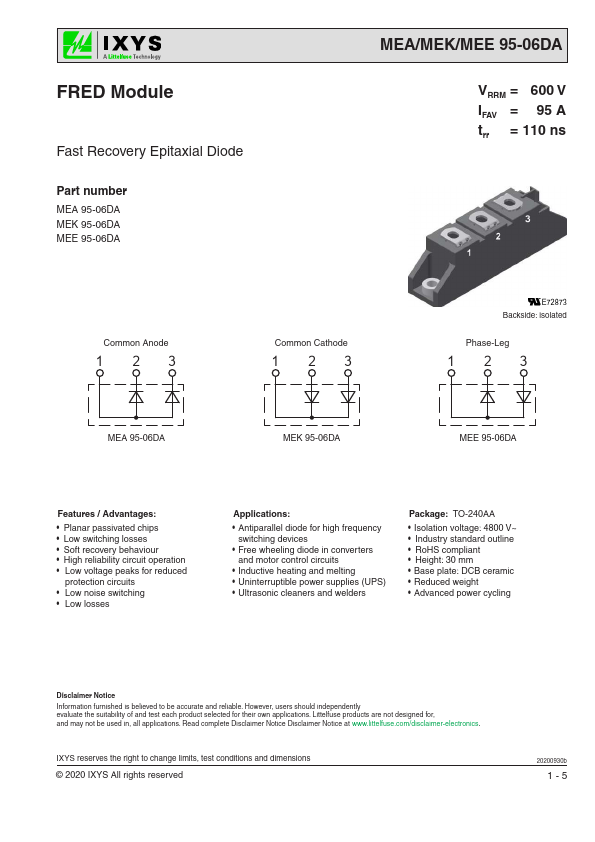
MEE95-06DA is Fast Recovery Epitaxial Diode manufactured by IXYS.
Features
/ Advantages:
- Planar passivated chips
- Low switching losses
- Soft recovery behaviour
- High reliability circuit operation
- Low voltage peaks for reduced protection circuits
- Low noise switching
- Low losses
Applications:
- Antiparallel diode for high frequency switching devices
- Free wheeling diode in converters and motor control circuits
- Inductive heating and melting
- Uninterruptible power supplies (UPS)
- Ultrasonic cleaners and welders
Package: TO-240AA
- Isolation voltage: 4800 V~
- Industry standard outline
- Ro HS pliant
- Height: 30 mm
- Base plate: DCB ceramic
- Reduced weight
- Advanced power cycling
Disclaimer Notice Information furnished is believed to be accurate and reliable. However, users should independently evaluate the suitability of and test each product selected for their own applications. Littelfuse products are not designed for, and may not be used in, all applications. Read plete Disclaimer Notice Disclaimer Notice at .littelfuse./disclaimer-electronics.
IXYS reserves the right to change limits, test conditions and dimensions © 2020 IXYS All rights reserved
20200930b
1-5
MEA/MEK/MEE 95-06DA
Diode Symbol VRSM VRRM IR
Definitions
Conditions max. non-repetitive reverse blocking voltage max. repetitive reverse blocking voltage reverse current forward voltage
VR = VRRM VR = 0.8- VRRM VR = 0.8- VRRM
IF = 100 A
IF = 300 A
IFRMS IFAV ① VT0 r T Rth JC Rth CH Ptot IFSM
I2t trr IRM
RMS forward current average forward current
TC = 75°C rectangular, d = 0.5 threshold voltage slope resistance for power-loss calculations only thermal resistance junction to case thermal resistance junction to heatsink max. surge forward current
I2t value for fusing max. reverse recovery current reverse recovery time t = 10 ms (50 Hz), sine t = 8.3 ms (60 Hz), sine t = 10 ms (50 Hz), sine t = 8.3 ms (60 Hz), sine t = 10 ms (50 Hz), sine t = 8.3 ms (60 Hz), sine t = 10 ms (50 Hz), sine t = 8.3 ms (60 Hz),...