Datasheet4U Logo Datasheet4U.com

CYT4BFBCHDQ0BZEGS - T2G 32-bit Automotive MCU

This page provides the datasheet information for the CYT4BFBCHDQ0BZEGS, a member of the CYT4BF T2G 32-bit Automotive MCU family.

Datasheet Summary

Description

CYT4BF is a family of TRAVEO™ T2G microcontrollers targeted at automotive systems such as high-end body-control units.

CYT4BF has two Arm® Cortex®-M7 CPUs for primary processing, and an Arm® Cortex®-M0+ CPU for peripheral and security processing.

Features

  • CPU subsystem - Two 350-MHz 32-bit Arm® Cortex®-M7 CPUs, each with.
  • Single-cycle multiply.
  • Single/double-precision floating point unit (FPU).
  • 16-KB data cache, 16-KB instruction cache.
  • Memory protection unit (MPU).
  • 16-KB instruction and 16-KB data tightly-coupled memories (TCM) - 100-MHz 32-bit Arm® Cortex® M0+ CPU with.
  • Single-cycle multiply.
  • Memory protection unit (MPU) - Inter-processor communication in hardware - Three.

📥 Download Datasheet

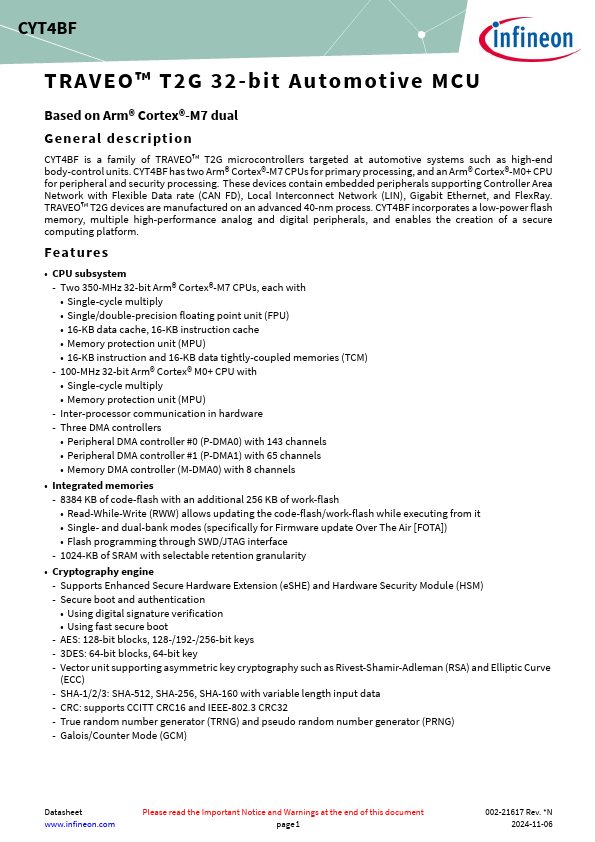
Datasheet preview – CYT4BFBCHDQ0BZEGS

Datasheet Details

Part number CYT4BFBCHDQ0BZEGS
Manufacturer Infineon
File Size 2.04 MB
Description T2G 32-bit Automotive MCU
Datasheet download datasheet CYT4BFBCHDQ0BZEGS Datasheet
Additional preview pages of the CYT4BFBCHDQ0BZEGS datasheet.
Other Datasheets by Infineon

Full PDF Text Transcription

Click to expand full text
CYT4BF TRAVEO™ T2G 32-bit Automotive MCU Based on Arm® Cortex®-M7 dual General description CYT4BF is a family of TRAVEO™ T2G microcontrollers targeted at automotive systems such as high-end body-control units. CYT4BF has two Arm® Cortex®-M7 CPUs for primary processing, and an Arm® Cortex®-M0+ CPU for peripheral and security processing. These devices contain embedded peripherals supporting Controller Area Network with Flexible Data rate (CAN FD), Local Interconnect Network (LIN), Gigabit Ethernet, and FlexRay. TRAVEO™ T2G devices are manufactured on an advanced 40-nm process. CYT4BF incorporates a low-power flash memory, multiple high-performance analog and digital peripherals, and enables the creation of a secure computing platform.
Published: |