ICS83905
ICS83905 is 1:6 CRYSTAL-TO-LVCMOS/LVTTL FANOUT BUFFER manufactured by Integrated Device Technology.
LOW SKEW, 1:6 CRYSTAL-TOLVCMOS/LVTTL FANOUT BUFFER
GENERAL DESCRIPTION
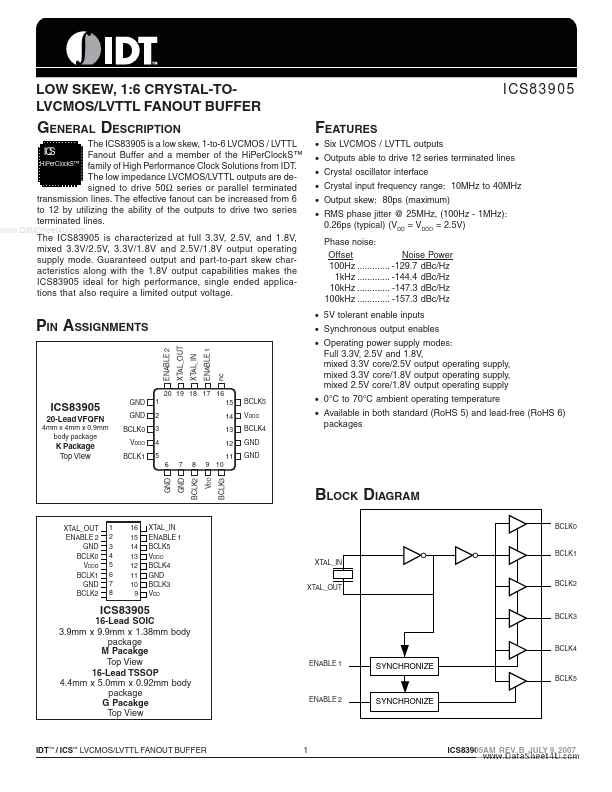
The ICS83905 is a low skew, 1-to-6 LVCMOS / LVTTL IC S Fanout Buffer and a member of the Hi Per Clock S™ Hi Per Clock S™ family of High Performance Clock Solutions from IDT. The low impedance LVCMOS/LVTTL outputs are designed to drive 50Ω series or parallel terminated transmission lines. The effective fanout can be increased from 6 to 12 by utilizing the ability of the outputs to drive two series terminated lines.
..
Features
- Six LVCMOS / LVTTL outputs
- Outputs able to drive 12 series terminated lines
- Crystal oscillator interface
- Crystal input frequency range: 10MHz to 40MHz
- Output skew: 80ps (maximum)
- RMS phase jitter @ 25MHz, (100Hz
- 1MHz): 0.26ps (typical) (VDD = VDDO = 2.5V) Phase noise: Offset Noise Power 100Hz ............. -129.7 d Bc/Hz 1k Hz ............. -144.4 d Bc/Hz 10k Hz ............. -147.3 d Bc/Hz 100k Hz ............. -157.3 d Bc/Hz
- 5V tolerant enable inputs
- Synchronous output enables
- Operating power supply modes: Full 3.3V, 2.5V and 1.8V, mixed 3.3V core/2.5V output operating supply, mixed 3.3V core/1.8V output operating supply, mixed 2.5V core/1.8V output operating supply
15 14 13 12 11 BCLK5 VDDO BCLK4 GND GND
The ICS83905 is characterized at full 3.3V, 2.5V, and 1.8V, mixed 3.3V/2.5V, 3.3V/1.8V and 2.5V/1.8V output operating supply mode. Guaranteed output and part-to-part skew characteristics along with the 1.8V output capabilities makes the ICS83905 ideal for high performance, single ended applications that also require a limited output voltage.
PIN ASSIGNMENTS
XTAL_OUT ENABLE 2 ENABLE 1 XTAL_IN nc
20 19 18 17 16
20-Lead VFQFN
4mm x 4mm x 0.9mm body package
GND GND BCLK0 VDDO BCLK1
1 2 3 4 5 6
- 0°C to 70°C ambient operating temperature
- Available in both standard (Ro HS 5) and lead-free (Ro HS 6) packages
K Package Top View
BCLK2
9 10
BCLK3...