KK74HCT10A
KK74HCT10A is Triple 3-Input NAND Gate manufactured by Kodenshi AUK Group.
TECHNICAL DATA
Triple 3-Input NAND Gate
High-Performance Silicon-Gate CMOS
The KK74HCT10A is identical in pinout to the LS/ALS10. The KK74HCT10A may be used as a level converter for interfacing TTL or NMOS outputs to High Speed CMOS inputs.
- TTL/NMOS patible Input Levels
- Outputs Directly Interface to CMOS, NMOS, and TTL
- Operating Voltage Range: 4.5 to 5.5 V
- Low Input Current: 1.0 µA
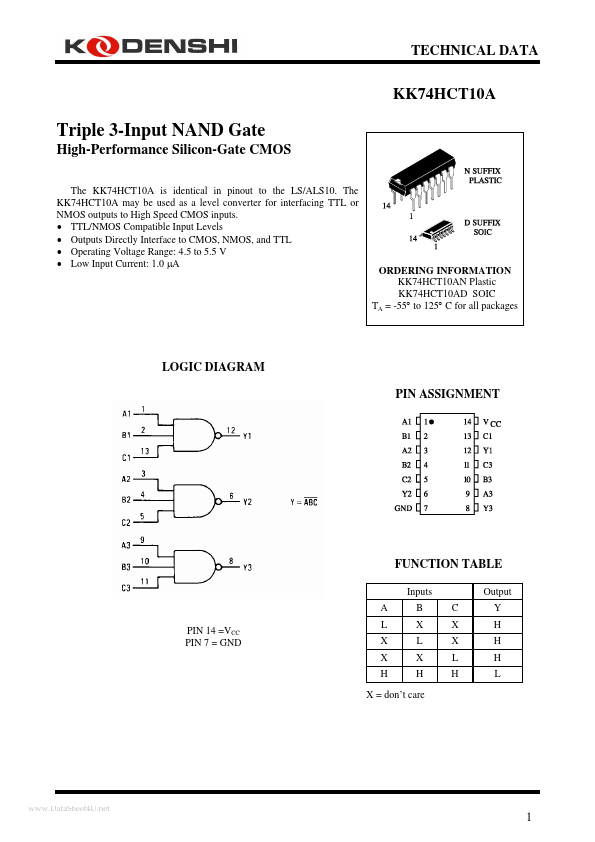
ORDERING INFORMATION KK74HCT10AN Plastic KK74HCT10AD SOIC TA = -55° to 125° C for all packages
LOGIC DIAGRAM PIN ASSIGNMENT
FUNCTION TABLE
Inputs A PIN 14 =VCC PIN 7 = GND L X X H B X L X H C X X L H Output Y H H H L
X = don’t care
..net
MAXIMUM RATINGS-
Symbol VCC VIN VOUT IIN IOUT ICC PD Tstg TL
- Parameter DC Supply Voltage (Referenced to GND) DC Input Voltage (Referenced to GND) DC Output Voltage (Referenced to GND) DC Input Current, per Pin DC Output Current, per Pin DC Supply Current, VCC and GND Pins Power Dissipation in Still Air, Plastic DIP+ SOIC Package+ Storage Temperature Lead Temperature, 1 mm from Case for 10 Seconds (Plastic DIP or SOIC Package)
Value -0.5 to +7.0 -1.5 to VCC +1.5 -0.5 to VCC +0.5 ±20 ±25 ±50 750 500 -65 to +150 260
Unit V V V m A m A m A m W °C °C
Maximum Ratings are those values beyond which damage to the device may occur. Functional operation should be restricted to the Remended Operating Conditions. +Derating
- Plastic DIP:
- 10 m W/°C from 65° to 125°C SOIC Package: :
- 7 m W/°C from 65° to 125°C
REMENDED OPERATING CONDITIONS
Symbol VCC VIN, VOUT TA tr, tf Parameter DC Supply Voltage (Referenced to GND) DC Input Voltage, Output Voltage (Referenced to GND) Operating Temperature, All Package Types Input Rise and Fall Time (Figure 1) Min 4.5 0 -55 0 Max 5.5 VCC +125 500 Unit V V °C ns
This device contains protection circuitry to guard against damage due to high static voltages or electric fields. However, precautions must be taken to avoid applications of any voltage higher than maximum...