LTC1757A-1
LTC1757A-1 is Single/Dual Band RF Power Controllers manufactured by Linear Technology.
LTC1757A-1/LTC1757A-2
Single/Dual Band RF Power Controllers
Features
DESCRIPTIO s Dual Band RF Power Amplifier Control (LTC1757A-2) s Improved Internal Schottky Diode Detector s Wide Input Frequency Range: 850MHz to 2GHz s Autozero Cancels Initial Offsets and Temperature
Dependent Offset Errors s Wide VIN Range of 2.7V to 6V Allows
Direct Connection to Battery s RF Output Power Set by External DAC s Fast Acquire After Transmit Enable s Internal Frequency pensation s Rail-to-Rail Power Control Outputs s RF PA Supply Current Limiting s Battery Overvoltage Protection s Power Control Signal Overvoltage Protection s Low Operating Current: 1m A s Very Low Shutdown Current: < 1µA s Available in a 8-Pin MSOP Package (LTC1757A-1) and 10-Pin MSOP (LTC1757A-2)
U APPLICATIO S s Single/Dual Band GSM Cellular Telephones s PCS Devices s Wireless Data Modems s TDMA Cellular Telephones
, LTC and LT are registered trademarks of Linear Technology Corporation.
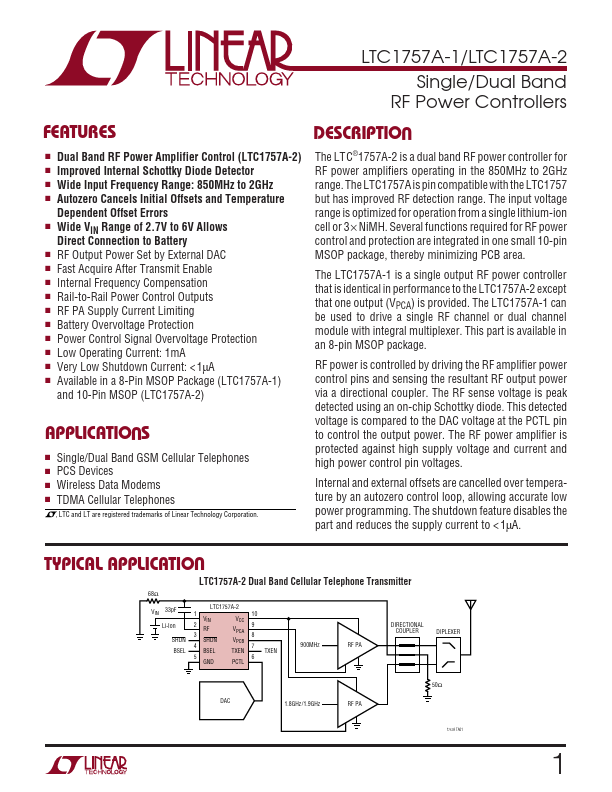
The LTC®1757A-2 is a dual band RF power controller for RF power amplifiers operating in the 850MHz to 2GHz range. The LTC1757A is pin patible with the LTC1757 but has improved RF detection range. The input voltage range is optimized for operation from a single lithium-ion cell or 3× Ni MH. Several functions required for RF power control and protection are integrated in one small 10-pin MSOP package, thereby minimizing PCB area.
The LTC1757A-1 is a single output RF power controller that is identical in performance to the LTC1757A-2 except that one output (VPCA) is provided. The LTC1757A-1 can be used to drive a single RF channel or dual channel module with integral multiplexer. This part is available in an 8-pin MSOP package.
RF power is controlled by driving the RF amplifier power control pins and sensing the resultant RF output power via a directional coupler. The RF sense voltage is peak detected using an on-chip Schottky diode. This detected voltage is pared to the DAC voltage at the PCTL pin to control the...