LTC3729L-6
LTC3729L-6 is Synchronous Step-Down Switching Regulator manufactured by Linear Technology.
Poly Phase, Synchronous Step-Down Switching Regulator
Features
DESCRIPTIO s Reduces Required Input Capacitance and Power Supply Induced Noise s True Remote Sensing Differential Amplifier s 0.6V, ±1% Voltage Reference Accuracy s Poly Phase Controller Operates from Two to Twelve
Phases s Current Mode Control Ensures Current Sharing s Phase-Lockable Fixed Frequency: 250k Hz to 550k Hz s OPTI-LOOP® pensation Reduces COUT s Power Good Output Voltage Monitor s Wide VIN Range: 4V to 30V Operation s Very Low Dropout Operation: 99% Duty Cycle s Adjustable Soft-Start Current Ramping s Internal Current Foldback Plus Shutdown Timer s Overvoltage Soft-Latch Eliminates Nuisance Trips s Micropower Shutdown s 32-Lead 5mm × 5mm Plastic QFN Package
U APPLICATIO S s Desktop puters s Internet Servers s Large Memory Arrays s DC Power Distribution Systems
, LTC and LT are registered trademarks of Linear Technology Corporation. OPTI-LOOP is a registered trademark of Linear Technology Corporation. Poly Phase is a trademark of Linear Technology Corporation.
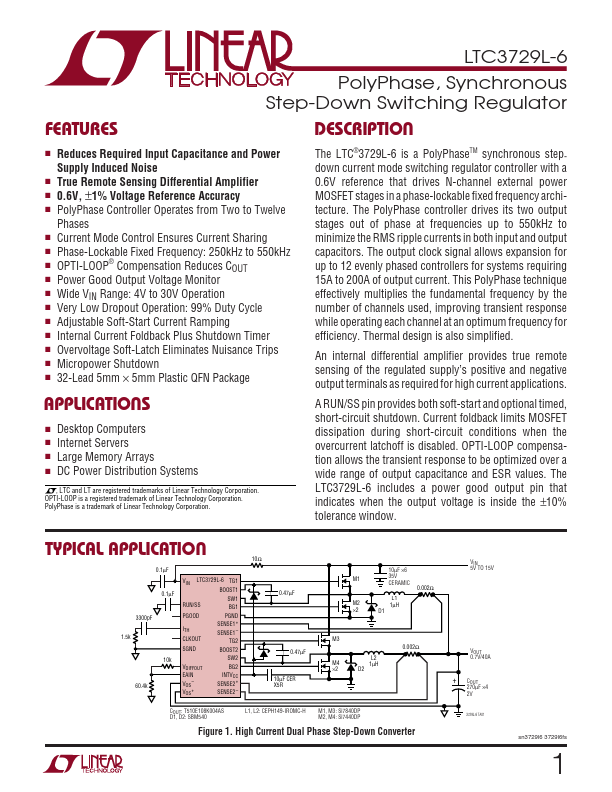
The LTC®3729L-6 is a Poly Phase TM synchronous stepdown current mode switching regulator controller with a 0.6V reference that drives N-channel external power MOSFET stages in a phase-lockable fixed frequency architecture. The Poly Phase controller drives its two output stages out of phase at frequencies up to 550k Hz to minimize the RMS ripple currents in both input and output capacitors. The output clock signal allows expansion for up to 12 evenly phased controllers for systems requiring 15A to 200A of output current. This Poly Phase technique effectively multiplies the fundamental frequency by the number of channels used, improving transient response while operating each channel at an optimum frequency for efficiency. Thermal design is also simplified.
An internal differential amplifier provides true remote sensing of the regulated supply’s positive and negative output terminals as required for high current...