LTC4120
LTC4120 is Wireless Power Receiver and 400mA Buck Battery Charger manufactured by Linear Technology.
LTC4120/LTC4120-4.2
Wireless Power Receiver and 400m A Buck Battery Charger
Features n Dynamic Harmonization Control Optimizes Wireless Charging Over a Wide Coupling Range n Wide Input Voltage Range: 12.5V to 40V n Adjustable Float Voltage: 3.5V to 11V n Fixed 4.2V Float Voltage Option: LTC4120-4.2 n50m A to 400m A Charge Current Programmed with a
Single Resistor n±1% Feedback Voltage Accuracy n Programmable 5% Accurate Charge Current n No Microprocessor Required n No Transformer Core n Thermally Enhanced, Low Profile 16-Lead
(3mm × 3mm × 0.75mm) QFN Package
Applications n Handheld Instruments n Industrial/Military Sensors and Devices n Harsh Environments n Portable Medical Devices n Physically Small Devices n Electrically Isolated Devices
L, LT, LTC, LTM, Linear Technology, the Linear logo and Burst Mode are registered trademarks of Linear Technology Corporation. All other trademarks are the property of their respective owners.
Description
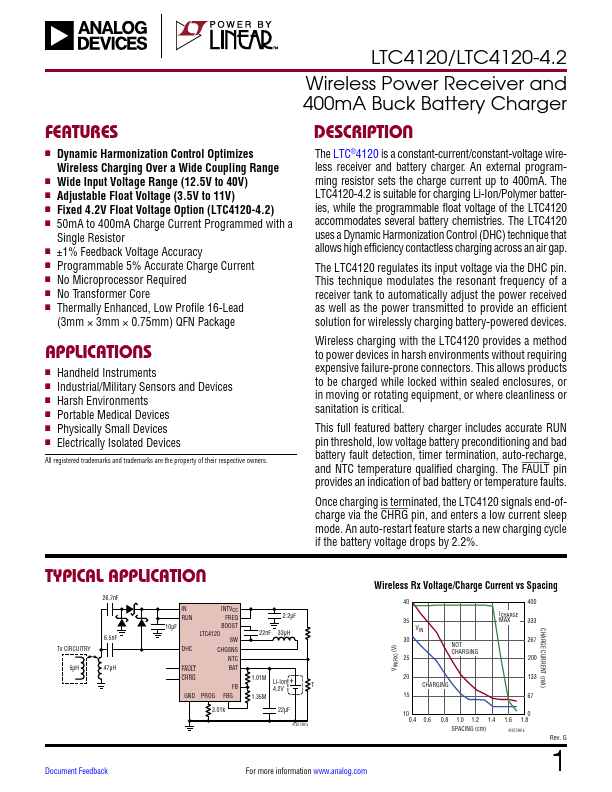
The LTC®4120 is a constant-current/constant-voltage wireless receiver and battery charger. An external programming resistor sets the charge current up to 400m A. The LTC4120-4.2 is suitable for charging Li-Ion/Polymer batteries, while the programmable float voltage of the LTC4120 acmodates several battery chemistries. The LTC4120 uses a Dynamic Harmonization Control (DHC) technique that allows high efficiency contactless charging across an air gap. The LTC4120 regulates its input voltage via the DHC pin. This technique modulates the resonant frequency of a receiver tank to automatically adjust the power received as well as the power transmitted to provide an efficient solution for wirelessly charging battery-powered devices. Wireless charging with the LTC4120 provides a method to power devices in harsh environments without requiring expensive failure-prone connectors. This allows products to be charged while locked within sealed enclosures, or in moving or rotating equipment, or where cleanliness or sanitation...