Datasheet4U Logo Datasheet4U.com

MP2162GQH - COT Synchronous Step Dwon Switcher

This page provides the datasheet information for the MP2162GQH, a member of the MP2162 COT Synchronous Step Dwon Switcher family.

Datasheet Summary

Description

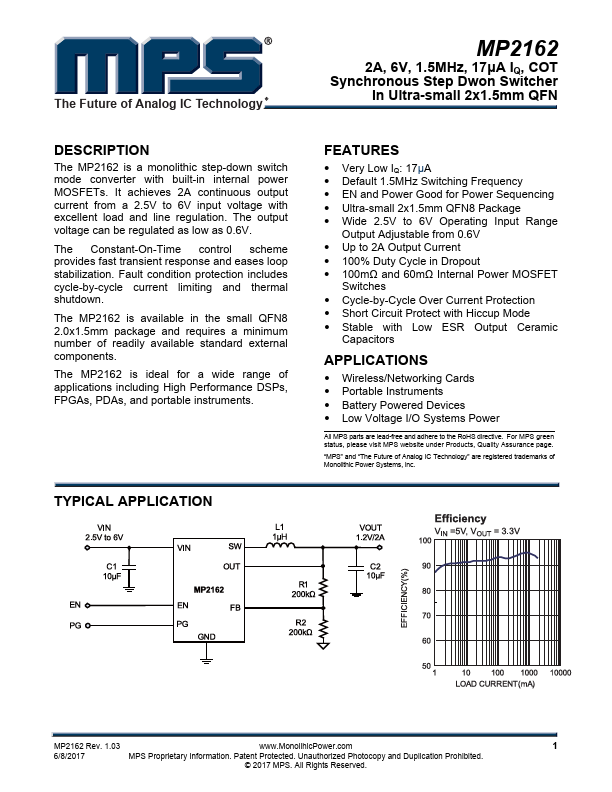
The MP2162 is a monolithic step-down switch mode converter with built-in internal power MOSFETs.

It achieves 2A continuous output current from a 2.5V to 6V input voltage with excellent load and line regulation.

The output voltage can be regulated as low as 0.6V.

Features

  • Very Low IQ: 17μA.
  • Default 1.5MHz Switching Frequency.
  • EN and Power Good for Power Sequencing.
  • Ultra-small 2x1.5mm QFN8 Package.
  • Wide 2.5V to 6V Operating Input Range Output Adjustable from 0.6V.
  • Up to 2A Output Current.
  • 100% Duty Cycle in Dropout.
  • 100mΩ and 60mΩ Internal Power MOSFET Switches.
  • Cycle-by-Cycle Over Current Protection.
  • Short Circuit Protect with Hiccup Mode.
  • Stable with Low ESR Output Ceramic Capacitors.

📥 Download Datasheet

Datasheet preview – MP2162GQH

Datasheet Details

Part number MP2162GQH
Manufacturer MPS
File Size 458.83 KB
Description COT Synchronous Step Dwon Switcher
Datasheet download datasheet MP2162GQH Datasheet
Additional preview pages of the MP2162GQH datasheet.
Other Datasheets by MPS

Full PDF Text Transcription

Click to expand full text
The Future of Analog IC Technology DESCRIPTION The MP2162 is a monolithic step-down switch mode converter with built-in internal power MOSFETs. It achieves 2A continuous output current from a 2.5V to 6V input voltage with excellent load and line regulation. The output voltage can be regulated as low as 0.6V. The Constant-On-Time control scheme provides fast transient response and eases loop stabilization. Fault condition protection includes cycle-by-cycle current limiting and thermal shutdown. The MP2162 is available in the small QFN8 2.0x1.5mm package and requires a minimum number of readily available standard external components. The MP2162 is ideal for a wide range of applications including High Performance DSPs, FPGAs, PDAs, and portable instruments.
Published: |