
Datasheet4U Logo Datasheet4U.com

MAX1693H - USB Current-Limited Switches

Download the MAX1693H datasheet PDF. This datasheet also covers the MAX1693 variant, as both devices belong to the same usb current-limited switches family and are provided as variant models within a single manufacturer datasheet.

General Description

The MAX1693/(MAX1693H)/MAX1694 are current-limited, 60mΩ switches with built-in fault blanking.

Their accurate preset current limit of 0.7A to 1.0A makes them ideally suited for USB applications.

Key Features

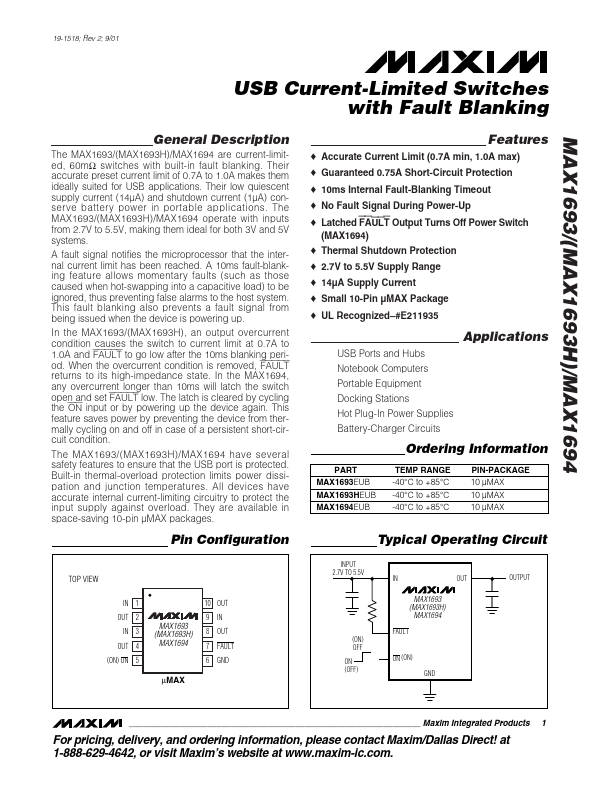
  • to ensure that the USB port is protected. Built-in thermal-overload protection limits power dissipation and junction temperatures. All devices have accurate internal current-limiting circuitry to protect the input supply against overload. They are available in space-saving 10-pin µMAX packages. Pin Configuration TOP VIEW IN 1 OUT 2 IN 3 OUT 4 (ON) ON 5 MAX1693 (MAX1693H) MAX1694 10 OUT 9 IN 8 OUT 7 FAULT 6 GND µMAX Features o Accurate Current Limit (0.7A min, 1.0A max) o Guaranteed 0.75A S.

📥 Download Datasheet

Note: The manufacturer provides a single datasheet file (MAX1693_MaximIntegratedProducts.pdf) that lists specifications for multiple related part numbers.

Full PDF Text Transcription (Reference)

The following content is an automatically extracted verbatim text from the original manufacturer datasheet and is provided for reference purposes only.

View original datasheet text
19-1518; Rev 2; 9/01 MAX1693/(MAX1693H)/MAX1694 USB Current-Limited Switches with Fault Blanking General Description The MAX1693/(MAX1693H)/MAX1694 are current-limited, 60mΩ switches with built-in fault blanking. Their accurate preset current limit of 0.7A to 1.0A makes them ideally suited for USB applications. Their low quiescent supply current (14µA) and shutdown current (1µA) conserve battery power in portable applications. The MAX1693/(MAX1693H)/MAX1694 operate with inputs from 2.7V to 5.5V, making them ideal for both 3V and 5V systems. A fault signal notifies the microprocessor that the internal current limit has been reached.