Datasheet4U Logo Datasheet4U.com

MIC23099 - Single AA/AAA Cell Step-Up/Step-Down Regulators

Datasheet Summary

Description

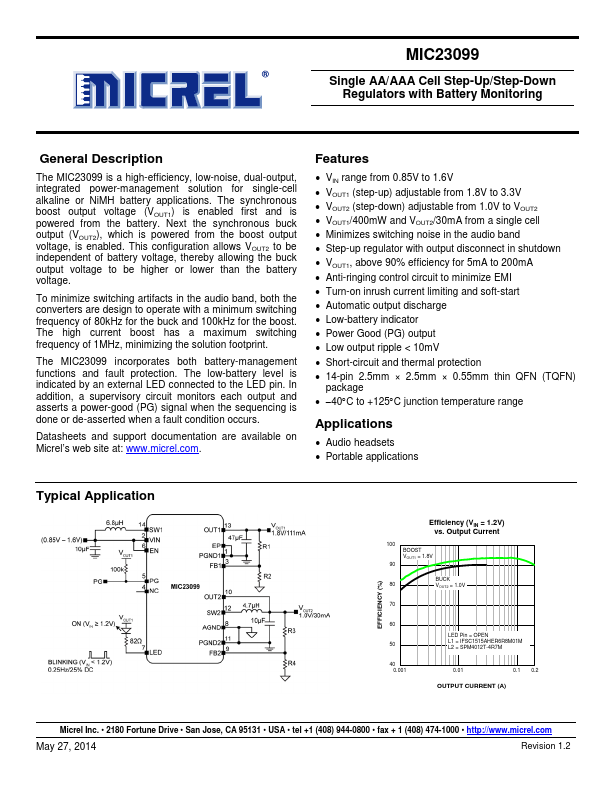
The MIC23099 is a high-efficiency, low-noise, dual-output, integrated power-management solution for single-cell alkaline or NiMH battery applications.

The synchronous boost output voltage (VOUT1) is enabled first and is powered from the battery.

Features

  • VIN range from 0.85V to 1.6V VOUT1 (step-up) adjustable from 1.8V to 3.3V VOUT2 (step-down) adjustable from 1.0V to VOUT2 VOUT1/400mW and VOUT2/30mA from a single cell Minimizes switching noise in the audio band Step-up regulator with output disconnect in shutdown VOUT1, above 90% efficiency for 5mA to 200mA Anti-ringing control circuit to minimize EMI Turn-on inrush current limiting and soft-start Automatic output discharge Low-battery indicator Power Good (PG) output Low output ripple < 10mV S.

📥 Download Datasheet

Datasheet preview – MIC23099

Datasheet Details

Part number MIC23099
Manufacturer Micrel Semiconductor
File Size 2.11 MB
Description Single AA/AAA Cell Step-Up/Step-Down Regulators
Datasheet download datasheet MIC23099 Datasheet
Additional preview pages of the MIC23099 datasheet.
Other Datasheets by Micrel Semiconductor

Full PDF Text Transcription

Click to expand full text
MIC23099 Single AA/AAA Cell Step-Up/Step-Down Regulators with Battery Monitoring General Description The MIC23099 is a high-efficiency, low-noise, dual-output, integrated power-management solution for single-cell alkaline or NiMH battery applications. The synchronous boost output voltage (VOUT1) is enabled first and is powered from the battery. Next the synchronous buck output (VOUT2), which is powered from the boost output voltage, is enabled. This configuration allows VOUT2 to be independent of battery voltage, thereby allowing the buck output voltage to be higher or lower than the battery voltage. To minimize switching artifacts in the audio band, both the converters are design to operate with a minimum switching frequency of 80kHz for the buck and 100kHz for the boost.
Published: |