Datasheet4U Logo Datasheet4U.com

ML6431 - Genlocking Sync Generator

Download the ML6431 datasheet PDF. This datasheet also covers the ML6430 variant, as both devices belong to the same genlocking sync generator family and are provided as variant models within a single manufacturer datasheet.

Features

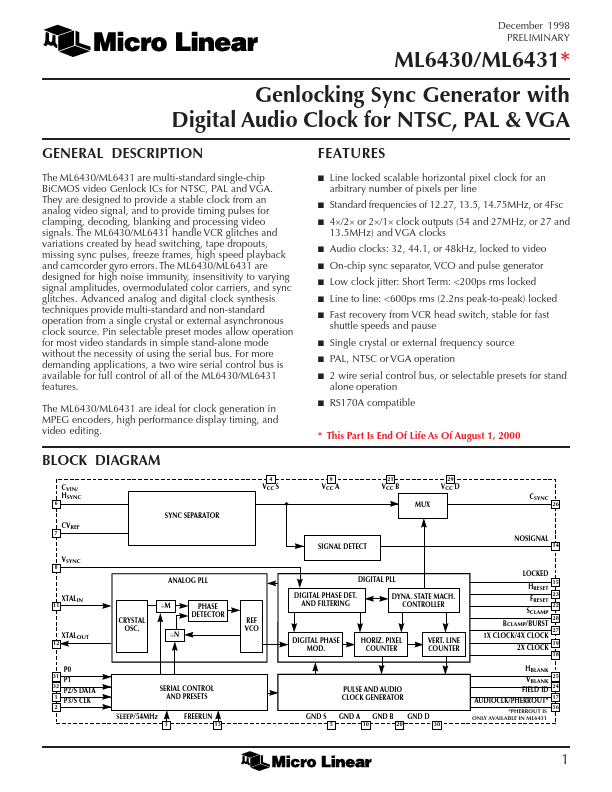
  • The ML6430/ML6431 are multi-standard single-chip BiCMOS video Genlock ICs for NTSC, PAL and VGA. They are designed to provide a stable clock from an analog video signal, and to provide timing pulses for clamping, decoding, blanking and processing video signals. The ML6430/ML6431 handle VCR glitches and variations created by head switching, tape dropouts, missing sync pulses, freeze frames, high speed playback and camcorder gyro errors. The ML6430/ML6431 are designed for high noise immunity, ins.

📥 Download Datasheet

Note: The manufacturer provides a single datasheet file (ML6430_MicroLinearCorporation.pdf) that lists specifications for multiple related part numbers.

Datasheet Details

Part number ML6431
Manufacturer Micro Linear
File Size 384.18 KB
Description Genlocking Sync Generator
Datasheet download datasheet ML6431 Datasheet

Full PDF Text Transcription (Reference)

The following content is an automatically extracted verbatim text from the original manufacturer datasheet and is provided for reference purposes only.

View original datasheet text
December 1998 PRELIMINARY ML6430/ML6431* Genlocking Sync Generator with Digital Audio Clock for NTSC, PAL & VGA GENERAL DESCRIPTION FEATURES The ML6430/ML6431 are multi-standard single-chip BiCMOS video Genlock ICs for NTSC, PAL and VGA. They are designed to provide a stable clock from an analog video signal, and to provide timing pulses for clamping, decoding, blanking and processing video signals. The ML6430/ML6431 handle VCR glitches and variations created by head switching, tape dropouts, missing sync pulses, freeze frames, high speed playback and camcorder gyro errors. The ML6430/ML6431 are designed for high noise immunity, insensitivity to varying signal amplitudes, overmodulated color carriers, and sync glitches.
Published: |