• Part: V58C2256404S
  • Description: HIGH PERFORMANCE 2.5 VOLT 256 Mbit DDR SDRAM
  • Manufacturer: Mosel Vitelic Corp
  • Size: 814.82 KB
Download V58C2256404S Datasheet PDF
Mosel Vitelic Corp
V58C2256404S
V58C2256404S is HIGH PERFORMANCE 2.5 VOLT 256 Mbit DDR SDRAM manufactured by Mosel Vitelic Corp.
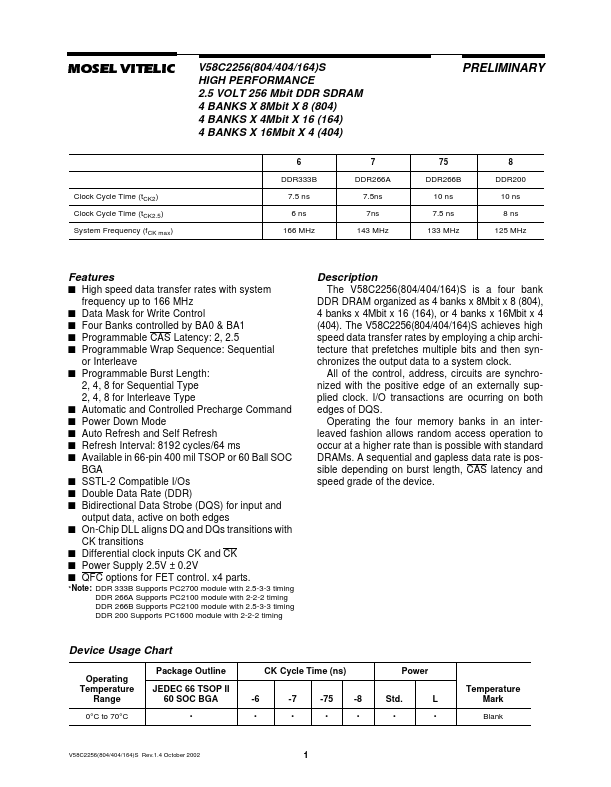
MOSEL VITELIC V58C2256(804/404/164)S HIGH PERFORMANCE 2.5 VOLT 256 Mbit DDR SDRAM 4 BANKS X 8Mbit X 8 (804) 4 BANKS X 4Mbit X 16 (164) 4 BANKS X 16Mbit X 4 (404) 6 DDR333B 7 DDR266A 7.5ns 7ns 143 MHz 75 DDR266B 10 ns 7.5 ns 133 MHz PRELIMINARY 8 DDR200 10 ns 8 ns 125 MHz Clock Cycle Time (t CK2) Clock Cycle Time (t CK2.5) System Frequency (f CK max ) 7.5 ns 6 ns 166 MHz Features - High speed data transfer rates with system frequency up to 166 MHz - Data Mask for Write Control - Four Banks controlled by BA0 & BA1 - Programmable CAS Latency: 2, 2.5 - Programmable Wrap Sequence: Sequential or Interleave - Programmable Burst Length: 2, 4, 8 for Sequential Type 2, 4, 8 for Interleave Type - Automatic and Controlled Precharge mand - Power Down Mode - Auto Refresh and Self Refresh - Refresh Interval: 8192 cycles/64 ms - Available in 66-pin 400 mil TSOP or 60 Ball SOC BGA - SSTL-2 patible I/Os - Double Data Rate (DDR) - Bidirectional Data Strobe (DQS) for input and output data, active on both edges - On-Chip DLL aligns DQ and DQs transitions with CK transitions - Differential clock inputs CK and CK - Power Supply 2.5V ± 0.2V - QFC options for FET control. x4 parts. - Note: DDR 333B Supports PC2700 module with 2.5-3-3 timing DDR 266A Supports PC2100 module with 2-2-2 timing DDR 266B Supports PC2100 module with 2.5-3-3 timing DDR 200 Supports PC1600 module with 2-2-2 timing Description The V58C2256(804/404/164)S is a four bank DDR DRAM organized as 4 banks x 8Mbit x 8 (804), 4 banks x 4Mbit x 16 (164), or 4 banks x 16Mbit x 4 (404). The V58C2256(804/404/164)S achieves high speed data transfer rates by employing a chip architecture that prefetches multiple bits and then synchronizes the output data to a system clock. All of the control, address, circuits are synchronized with the positive edge of an externally supplied clock. I/O transactions are ocurring on both edges of DQS. Operating the four memory banks in an interleaved fashion allows random access operation...