Datasheet4U Logo Datasheet4U.com

74AUP1G08 - Low-power 2-input AND gate

Description

The 74AUP1G08 is a high-performance, low-power, low-voltage, Si-gate CMOS device, superior to most advanced CMOS compatible TTL families.

Schmitt-trigger action at all inputs makes the circuit tolerant to slower input rise and fall times across the entire VCC range from 0.8 V to 3.6 V.

Features

  • s Wide supply voltage range from 0.8 V to 3.6 V s High noise immunity s Complies with JEDEC standards: x JESD8-12 (0.8 V to 1.3 V) x JESD8-11 (0.9 V to 1.65 V) x JESD8-7 (1.2 V to 1.95 V) x JESD8-5 (1.8 V to 2.7 V) x JESD8-B (2.7 V to 3.6 V) s ESD protection: x HBM JESD22-A114-C Class 3A. Exceeds 5000 V x MM JESD22-A115-A exceeds 200 V x CDM JESD22-C101-C exceeds 1000 V s Low static power consumption; ICC = 0.9 µA (maximum) s Latch-up performance exceeds 100 mA per JESD 78 Class II s Inputs acce.

📥 Download Datasheet

Datasheet preview – 74AUP1G08

Datasheet Details

Part number 74AUP1G08
Manufacturer NXP Semiconductors
File Size 127.81 KB
Description Low-power 2-input AND gate
Datasheet download datasheet 74AUP1G08 Datasheet
Additional preview pages of the 74AUP1G08 datasheet.
Other Datasheets by NXP Semiconductors

Full PDF Text Transcription

Click to expand full text
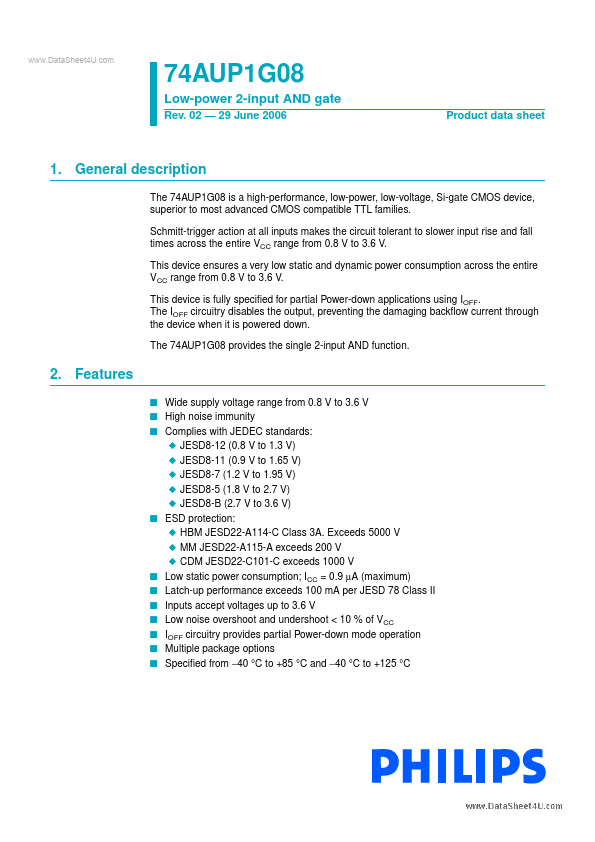
www.DataSheet4U.com 74AUP1G08 Low-power 2-input AND gate Rev. 02 — 29 June 2006 Product data sheet 1. General description The 74AUP1G08 is a high-performance, low-power, low-voltage, Si-gate CMOS device, superior to most advanced CMOS compatible TTL families. Schmitt-trigger action at all inputs makes the circuit tolerant to slower input rise and fall times across the entire VCC range from 0.8 V to 3.6 V. This device ensures a very low static and dynamic power consumption across the entire VCC range from 0.8 V to 3.6 V. This device is fully specified for partial Power-down applications using IOFF. The IOFF circuitry disables the output, preventing the damaging backflow current through the device when it is powered down. The 74AUP1G08 provides the single 2-input AND function. 2.
Published: |