DP8430V
DP8430V is microCMOS Programmable 256k/1M/4M Dynamic RAM Controller/Drivers manufactured by National Semiconductor.
- Part of the DP8432V comparator family.
- Part of the DP8432V comparator family.
Description
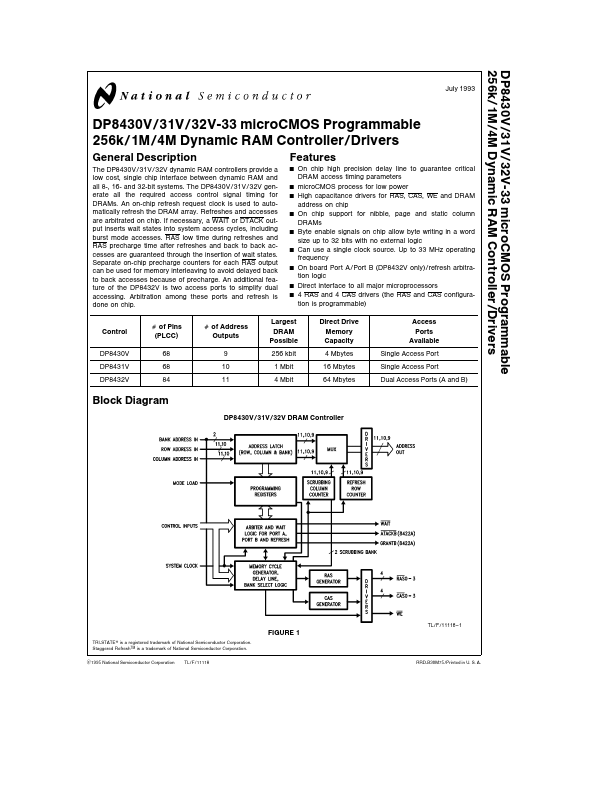
The DP8430V 31V 32V dynamic RAM controllers provide a low cost single chip interface between dynamic RAM and all 8- 16- and 32-bit systems The DP8430V 31V 32V generate all the required access control signal timing for DRAMs An on-chip refresh request clock is used to automatically refresh the DRAM array Refreshes and accesses are arbitrated on chip If necessary a WAIT or DTACK output inserts wait states into system access cycles including burst mode accesses RAS low time during refreshes and RAS precharge time after refreshes and back to back accesses are guaranteed through the insertion of wait states Separate on-chip precharge counters for each RAS output can be used for memory interleaving to avoid delayed back to back accesses because of precharge An additional feature of the DP8432V is two access ports to simplify dual accessing Arbitration among these ports and refresh is done on chip of Pins (PLCC) 68 68 84 of Address Outputs 9 10 11
Features
On chip high precision delay line to guarantee critical DRAM access timing parameters micro CMOS process for low power High capacitance drivers for RAS CAS WE and DRAM address on chip On chip support for nibble page and static column DRAMs Byte enable signals on chip allow byte writing in a word size up to 32 bits with no external logic Can use a single clock source Up to 33 MHz operating frequency On board Port A Port B (DP8432V only) refresh arbitration logic Direct interface to all major microprocessors 4 RAS and 4 CAS drivers (the RAS and CAS configuration is programmable) Direct Drive Memory Capacity 4 Mbytes 16 Mbytes 64 Mbytes Access Ports Available Single Access Port Single Access Port Dual Access Ports (A and B)
Control DP8430V DP8431V DP8432V
Largest DRAM Possible 256 kbit 1 Mbit 4 Mbit
Block Diagram
DP8430V 31V 32V DRAM Controller
TL F 11118
- 1
FIGURE 1
TRI-STATE is a registered trademark of National Semiconductor Corporation Staggered Refresh TM is a trademark of...