LMS75LBC176
LMS75LBC176 is Differential Bus Transceivers manufactured by National Semiconductor.
Description
The LMS75LBC176 is a differential bus/line transceiver designed for bidirectional data munication on multipoint bus transmission lines. It is designed for balanced transmission lines. It meets TIA/EIA RS485 and ISO 8482:1987(E). The LMS75LBC176 bines a TRI-STATE™ differential line driver and differential input receiver, both of which operate from a single 5.0V power supply. The driver and receiver have an active high and active low enable, respectively, that can be externally connected to function as a direction control. The driver and receiver differential inputs are internally connected to form differential input/output (I/O) bus ports that are designed to offer minimum loading to bus whenever the driver is disabled or when VCC = 0V. These ports feature wide positive and negative mon mode voltage ranges, making the device suitable for multipoint applications in noisy environments. The LMS75LBC176 is available in a 8-Pin SOIC package. It is a drop-in socket replacement to TI’s SN75LBC176.
Features n n n n n n n n n n n n n n Bidirectional transceiver Meet ANSI standard RS-485 Low skew, 6ns Low supply current, 8m A (max) Wide input and output voltage range High output drive capacity ± 60m A Thermal shutdown protection Open circuit fail-safe for receiver Receiver input sensitivity ± 200m V Receiver input hysteresis 10m V (min.) Single supply voltage operation, 5V Glitch free power-up and power-down operation Pin and functional patible with TI’s SN75LBC176 8-Pin SOIC
Applications n n n n n Network hubs, bridges, and routers Point of sales equipment (ATM, barcode readers,…) Industrial programmable logic controllers High speed parallel and serial applications Multipoint applications with noisy environment
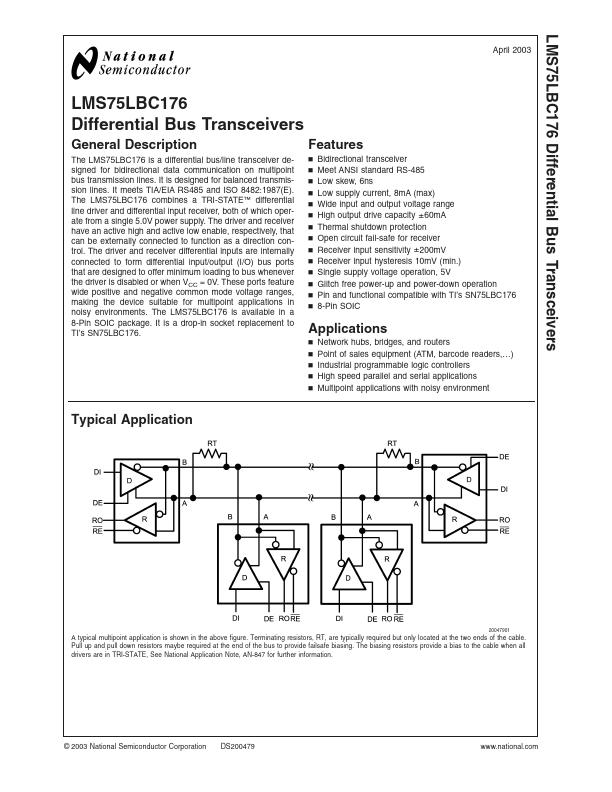
Typical Application
A typical multipoint application is shown in the above figure. Terminating resistors, RT, are typically required but only located at the two ends of the cable. Pull up and pull down resistors maybe required at the end of the...