DM8899
DM8899 is TRI-STATE BCD to Binary/Binary to BCD Converters manufactured by National Semiconductor.
- Part of the DM8898 comparator family.
- Part of the DM8898 comparator family.
Description
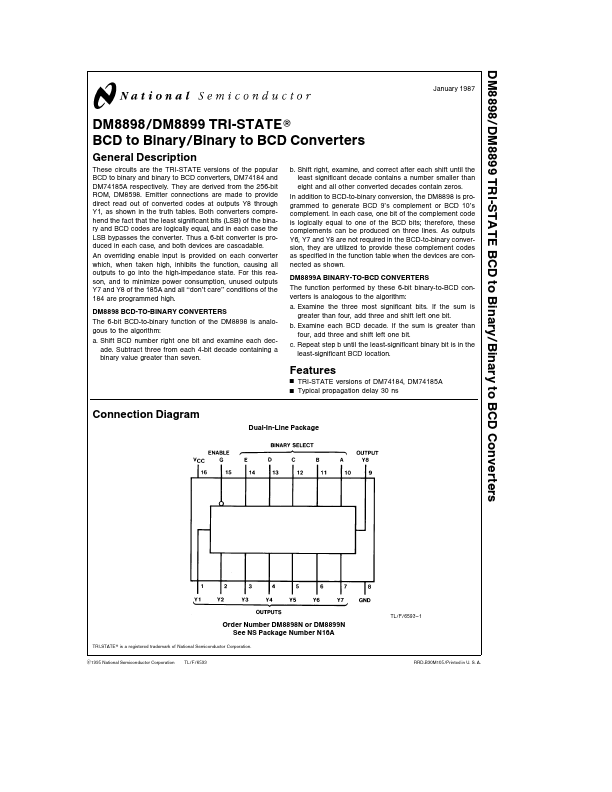
These circuits are the TRI-STATE versions of the popular BCD to binary and binary to BCD converters DM74184 and DM74185A respectively They are derived from the 256-bit ROM DM8598 Emitter connections are made to provide direct read out of converted codes at outputs Y8 through Y1 as shown in the truth tables Both converters prehend the fact that the least significant bits (LSB) of the binary and BCD codes are logically equal and in each case the LSB bypasses the converter Thus a 6-bit converter is produced in each case and both devices are cascadable An overriding enable input is provided on each converter which when taken high inhibits the function causing all outputs to go into the high-impedance state For this reason and to minimize power consumption unused outputs Y7 and Y8 of the 185A and all ‘‘don’t care’’ conditions of the 184 are programmed high DM8898 BCD-TO-BINARY CONVERTERS The 6-bit BCD-to-binary function of the DM8898 is analogous to the algorithm a Shift BCD number right one bit and examine each decade Subtract three from each 4-bit decade containing a binary value greater than seven b Shift right examine and correct after each shift until the least significant decade contains a number smaller than eight and all other converted decades contain zeros In addition to BCD-to-binary conversion the DM8898 is programmed to generate BCD 9’s plement or BCD 10’s plement In each case one bit of the plement code is logically equal to one of the BCD bits therefore these plements can be produced on three lines As outputs Y6 Y7 and Y8 are not required in the BCD-to-binary conversion they are utilized to provide these plement codes as specified in the function table when the devices are connected as shown DM8899A BINARY-TO-BCD CONVERTERS The function performed by these 6-bit binary-to-BCD converters is analogous to the algorithm a Examine the three most significant bits If the sum is greater than four add three and shift left one bit b Examine each BCD...