LMV796
LMV796 is 1.8V Operational Amplifiers manufactured by National Semiconductor.
Description
The LMV796 (Single) and the LMV797 (Dual) low noise, CMOS input operational amplifiers offer a low input voltage while consuming only 1.15 m A noise density of 5.8 n V/ (LMV796) of quiescent current. The LMV796 and LMV797 are unity gain stable op amps and have gain bandwidth of 17 .. MHz. The LMV796/ LMV797 have a supply voltage range of 1.8V to 5.5V and can operate from a single supply. The LMV796/LMV797 each feature a rail-to-rail output stage capable of driving a 600Ω load and sourcing as much as 60 m A of current. The LMV796 family provides optimal performance in low voltage and low noise systems. A CMOS input stage, with typical input bias currents in the range of a few femto Amperes, and an input mon mode voltage range, which includes ground, make the LMV796 and the LMV797 ideal for low power sensor applications. The LMV796/LMV797 are manufactured using National’s advanced VIP50 process and are offered in a 5-pin SOT23 and an 8-pin MSOP package respectively.
Features
(Typical 5V supply, unless otherwise noted) n Input referred voltage noise 5.8 n V/ n Input bias current 100 f A n Unity gain bandwidth 17 MHz n Supply current per channel
- LMV796 1.15 m A
- LMV797 1.30 m A n Rail-to-rail output swing
- @ 10 kΩ load 25 m V from rail 35 m V from rail
- @ 2 kΩ load n Guaranteed 2.5V and 5.0V performance n Total harmonic distortion 0.01% @1 k Hz, 600Ω n Temperature range
- 40˚C to 125˚C
Applications n n n n n Photodiode amplifiers Active filters and buffers Low noise signal processing Medical instrumentation Sensor interface applications
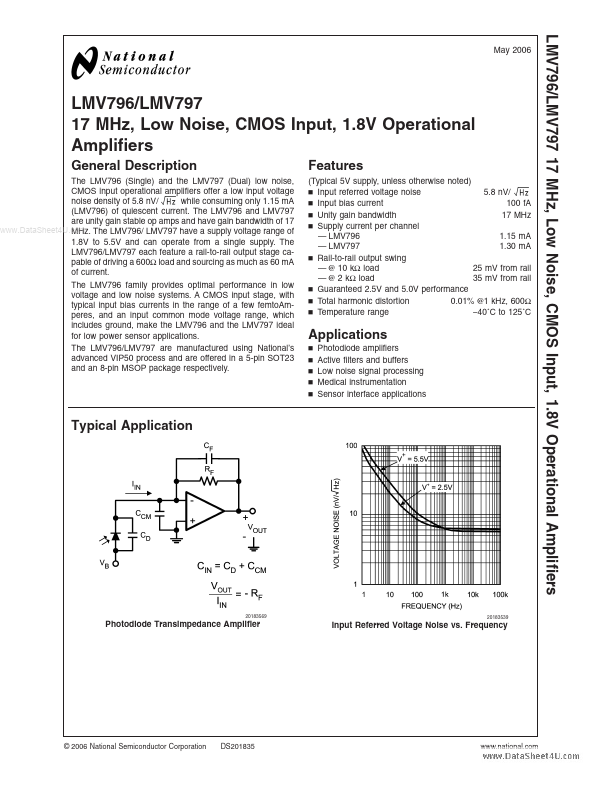
Typical Application
Photodiode Transimpedance Amplifier
Input Referred Voltage Noise vs. Frequency
© 2006 National Semiconductor Corporation
DS201835
.national.
LMV796/LMV797
Absolute Maximum Ratings (Note 1)
If Military/Aerospace specified devices are required, please contact the National Semiconductor Sales Office/ Distributors for availability and specifications. ESD Tolerance (Note 2) Human Body...