LPC662
LPC662 is Low Power CMOS Dual Operational Amplifier manufactured by National Semiconductor.
Description
The LPC662 CMOS Dual operational amplifier is ideal for operation from a single supply. It features a wide range of operating voltage from +5V to +15V, rail-to-rail output swing in addition to an input mon-mode range that includes ground. Performance limitations that have plagued CMOS amplifiers in the past are not a problem with this design. Input VOS, drift, and broadband noise as well as voltage gain (into 100 kΩ and 5 kΩ) are all equal to or better than widely accepted bipolar equivalents, while the power supply requirement is typically less than 0.5 m W.
This chip is built with National’s advanced Double-Poly Silicon-Gate CMOS process.
See the LPC660 datasheet for a Quad CMOS operational amplifier and LPC661 for a single CMOS operational amplifier with these same features
.
Applications n High-impedance buffer n Precision current-to-voltage converter n Long-term integrator n High-impedance preamplifier n Active filter n Sample-and-Hold circuit n Peak detector
Features n Rail-to-rail output swing n Micropower operation (<0.5 m W) n Specified for 100 kΩ and 5 kΩ loads n High voltage gain
120 d B n Low input offset voltage
3 m V n Low offset voltage drift
1.3 µV/˚C n Ultra low input bias current
2 f A n Input mon-mode includes GND n Operating range from +5V to +15V n Low distortion
0.01% at 1 k Hz n Slew rate
0.11 V/µs n Full military temperature range available
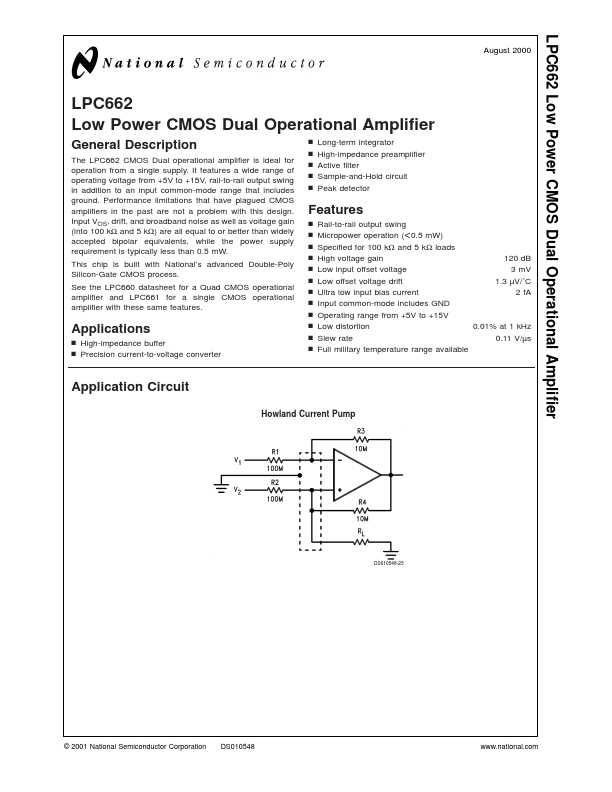
Application Circuit
Howland Current Pump
DS010548-23
© 2001 National Semiconductor Corporation DS010548
.national.
Absolute Maximum Ratings (Note 3)
If Military/Aerospace specified devices are required, please contact the National Semiconductor Sales Office/Distributors for availability and specifications.
Differential Input Voltage Supply Voltage (V+
- V- ) Output Short Circuit to V+ Output Short Circuit to V- Lead Temperature
(Soldering, 10 sec.) Storage Temp. Range Junction Temperature ESD Rating
(C = 100 p F, R = 1.5 kΩ) Power Dissipation Current at Input Pin...