Datasheet4U Logo Datasheet4U.com

SM5301AS - 3-channel Video Buffer

General Description

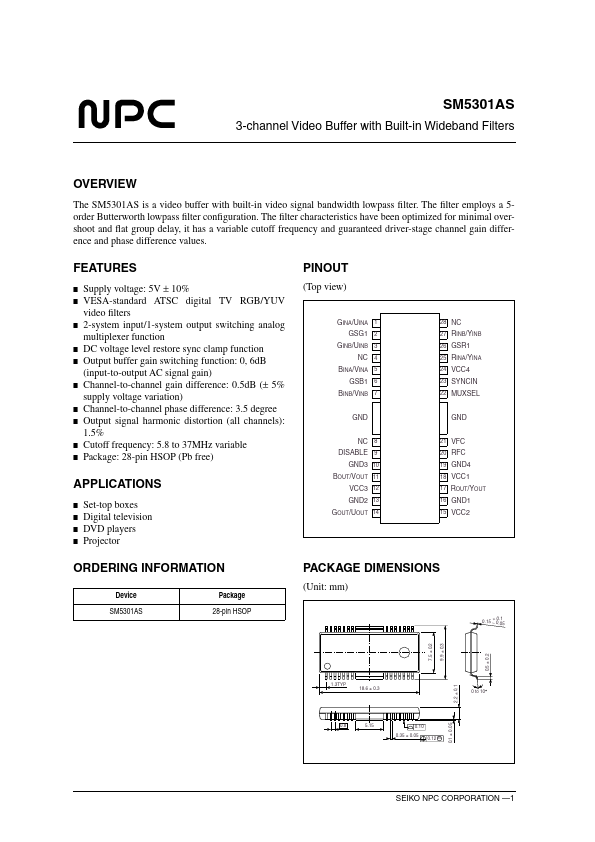
Number 1 2 3 4 5 6 7 8 9 10 11 12 13 14 15 16 17 18 19 20 21 22 23 24 25 26 27 28 Name GINA/UINA GSG1 GINB/UINB NC BINA/VINA GSB1 BINB/VINB NC DISABLE GND3 BOUT/VOUT VCC3 GND2 GOUT/UOUT VCC2 GND1 ROUT/YOUT VCC1 GND4 RFC VFC MUXSEL SYNCIN VCC4 RINA/YINA GSR1 RINB/YINB NC I/O Description I Analog G

Key Features

  • I Supply voltage: 5V ± 10% I VESA-standard ATSC digital TV RGB/YUV video filters I 2-system input/1-system output switching analog multiplexer function I DC voltage level restore sync clamp function I Output buffer gain switching function: 0, 6dB (input-to-output AC signal gain) I Channel-to-channel gain difference: 0.5dB (± 5% supply voltage variation) I Channel-to-channel phase difference: 3.5 degree I Output signal harmonic distortion (all channels): 1.5% I Cutoff frequency: 5.8 to 37MHz varia.

📥 Download Datasheet

Datasheet Details

Part number SM5301AS
Manufacturer Nippon Precision Circuits
File Size 162.72 KB
Description 3-channel Video Buffer
Datasheet download datasheet SM5301AS Datasheet

Full PDF Text Transcription (Reference)

The following content is an automatically extracted verbatim text from the original manufacturer datasheet and is provided for reference purposes only.

View original datasheet text
SM5301AS 3-channel Video Buffer with Built-in Wideband Filters OVERVIEW The SM5301AS is a video buffer with built-in video signal bandwidth lowpass filter. The filter employs a 5order Butterworth lowpass filter configuration. The filter characteristics have been optimized for minimal overshoot and flat group delay, it has a variable cutoff frequency and guaranteed driver-stage channel gain difference and phase difference values. FEATURES I Supply voltage: 5V ± 10% I VESA-standard ATSC digital TV RGB/YUV video filters I 2-system input/1-system output switching analog multiplexer function I DC voltage level restore sync clamp function I Output buffer gain switching function: 0, 6dB (input-to-output AC signal gain) I Channel-to-channel gain difference: 0.