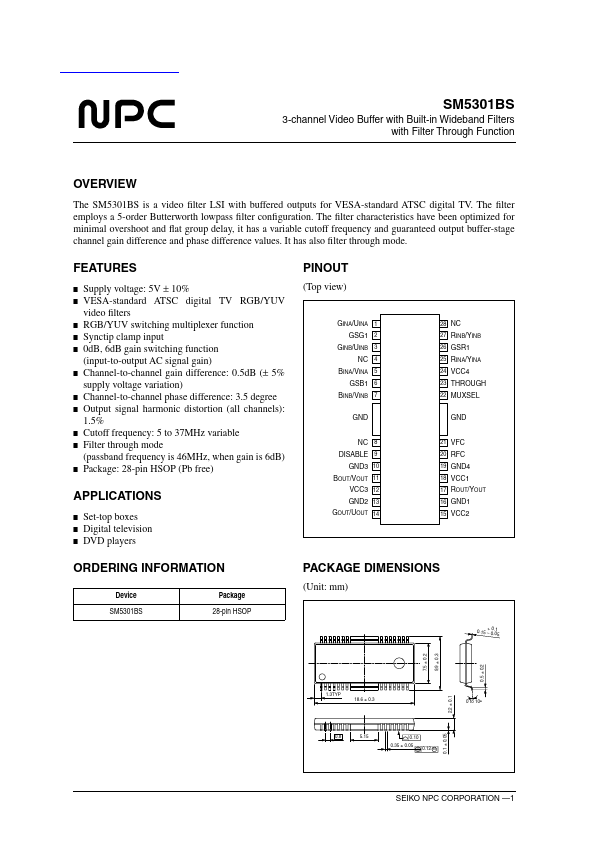
Description
GINA or UINA signal input 2 GSG1 Ipu GOUT/UOUT output buffer gain set input 3 GINB/UINB I Analog GINB or UINB signal input 4 NC - No connection (leave open or connect to ground) 5 BINA/VINA I Analog BINA or VINA signal input 6 GSB1 Ipu BOUT/VOUT output buffer gain set input 7 BINB/VINB I Analog BINB or VINB signal input 8 NC - No connection (leave open or connect to ground) Power save function 9 DISABLE Ipd L: Enable H: Disable (Output pins: ROUT/YOUT, GOUT/UOUT, and BOUT/VOUT are high impedance.) 10 GND3 - Analog ground 11 BOUT/VOUT O B/V signal output 12 VCC3 - Analog 5V supply 13 GND2 - Analog ground 14 GOUT/UOUT O G/U signal output 15 VCC2 - Analog 5V supply 16 GND1 - Analog ground 17 ROUT/YOUT O R/Y signal output 18 VCC1 - Analog 5V supply 19 GND4 - Analog ground 20 RFC - LPF (lowpass filter) cutoff frequency setting resistor connection 21 VFC I LPF (lowpass filter) cutoff frequency setting voltage input Input select signal 22 MUXSEL Ipd L: ×INA pin select H: ×INB pin select Filter mode select pin 23 THROUGH Ipd L: Filter mode H: Filter through mode 24 VCC4 - Analog 5V supply 25 RINA/YINA I Analog RINA or YINA signal input 26 GSR1 Ipu ROUT/YOUT output buffer gain set input 27 RINB/YINB I Analog RINB or YINB signal input 28 NC - No connection (leave open or connect to ground) 1.